--%>

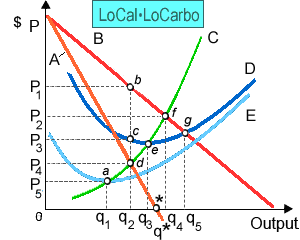
Minimize average total costs

LoCalLoCarbo that is Favorite Corporation of fad dieters, which can minimize its average total costs near producing: (i) output q1 at point a. (ii) output q2 at point b. (iii) output q3 at point e. (iv) output q4 at point f. (v) output q5 at point g.
787_Market Power and Marginal Revenue.png

Can someone explain/help me with best solution about problem of Economics...

   Related Questions in Microeconomics

  • Q : Decrease transportation and transaction

    The value of land is attributable to the ways exactly sites decrease transportation and other transaction costs are termed as: (1) location rents. (2) transportation rents. (3) short term quasi rents. (4) parcel posts. (5) transaction

  • Q : Characterized monopolistic competition

    Monopolistic competition is NOT described by: (1) P = MSC. (2) large numbers of sellers. (3) P = LRATC. (4) MR = MC. (5) differentiated products. Hey friends please give your opinion for the problem of Econ

  • Q : Consequence of successful product

    Maggie thinks there are main differences among Crest, Colgate, Aquafresh and Rembrandt toothpastes, and eventually chooses Crest. Therefore her perception is mainly a consequence of: (1) successful product differentiation. (2) monopolistic competition. (3) informative

  • Q : Annuity of the Perpetuity Dividing the

    Dividing the annuity of the perpetuity by the interest rate gives in the perpetuity’s: (w) rate of return. (x) present value. (y) internal rate of discount. (z) capitalization rate. Can someo

  • Q : Problem on least monopsony power The

    The Firms which have at least some monopsony power will never: (i) Practice wage discrimination. (ii) Find out wage rates in portion by the number of workers it hires. (iii) Pay higher wages than would a firm hiring from the competitive labor market. (iv) Raise the em

  • Q : Rational consumer-Relative Prices I

    I have a problem in economics on rational consumer-Relative Prices. Please help me in the following question. The rational consumer purchasing decisions depend mainly on: (1) Current market prices. (2) Absolute prices. (3) Nominal prices. (4) Monetary prices. (5) Rela

  • Q : Nominal wages If the nominal wages of

    If the nominal wages of carpenters rose by 5 percent in the year of 2000 and the price level increased by 3 percent, then the real wages of carpenters: A) decreased by 2 percent. B) increased by 2 percent. C) increased by 3 percent. D) increased by 8 percent.

  • Q : Demands for productive resources The

    The demands for productive resources are eventually “derived” by the: (w) marginal utility they directly generate. (x) demands for consumer goods and services. (y) disutility incurred in supplying labor. (z) equity of resource owners as ju

  • Q : Unitary price elasticity demand For

    For Cournot’s Spring Water the demand has unitary price elasticity at: (i) point a. (ii) point b. (iii) point c (iv) point d. (v) point e.

    Q : NOT price discriminate by monopoly Into

    Into equilibrium, a monopoly which does NOT price discriminate will tend to produce: (w) the socially optimal rate of output. (x) a level of output where price exceeds marginal social cost. (y) lower output at lower prices than a competitive market. (