--%>

Maximum total revenue for elasticity of demand

The elasticity of demand equals one and consumer spending upon Robot Butlers (there is the firm’s total revenue), is at a maximum at a price of as: (1) $20,000. (2) $15,000. (3) $10,000. (4) $5,000. (5) zero.
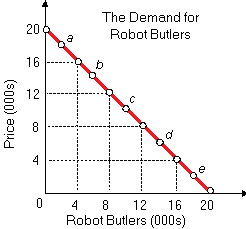
552_Price Elasticity of Demand3.png

Please choose the right answer from above...I want your suggestion for the same.

   Related Questions in Microeconomics

  • Q : Scarcity of good in market problem In

    In the market of papayas: (1) A scarcity exists at P2. (2) Papayas are a free good at P0. (3) Papayas are presently a scarce good. (4) Consumer’s demand prices equivalent P2 at quantity Q2. (5) Equilibrium price for papayas be P0.

    Q : Find linear demand curve by quantity

    Along this illustrated linear demand curve, there is: (1) inelastic portion is range a. (2) elastic portion is range b. (3) midpoint is unitarily price elastic. (4) elasticity is constant in each and every ranges. (5) midpoint elasticity becomes infin

  • Q : Movement of Supply Curve towards up and

    The rise in the price of Pepsi will effect a: (1) Shift of the supply curve of Coke to left. (2) Shift of the supply curve of Pepsi to right. (3) Movement downwards all along the supply curve of Coke. (4) Movement up and to right all along the supply curve of Pepsi.

  • Q : Purely competitive market at

    For a purely competitive market at any equilibrium point on the short-run supply curve: (w) all firms have identical marginal costs. (x) economic profit is positive. (y) accounting profit is normal. (z) marginal revenue = average cost.

    Q : Marginal revenue and average revenue

    A firm along with market power faces a downward sloping demand curve since: (w) selling more of the good needs a price cut. (x) marginal revenue should equal average revenue. (y) only pure monopolies face horizontal demand curves. (z)

  • Q : Coefficient of cross-elasticity of

    When a price hike from $15 to $20 for DVD disks causes sales of DVD players to reduce from 100 to 50 units, in that case the coefficient of cross-elasticity of demand among these goods is approximately: (w) 1/10. (x)  10. (y)  7/3. (z) 

  • Q : Competition in Labor Markets The

    The horizontal labor supply curve signifies that: (i) The supply of labor is perfectly inelastic. (ii) The firm can hire as much labor as it requires at going wage rate. (iii) Labor and capital are in the fixed supply. (iv) Marginal physical product of the labor is co

  • Q : Demand and supply An increase in

    An increase in consumer desire for strawberries is most likely to: A) increase the number of strawberry pickers needed by farmers. B) reduce the supply of strawberries. C) reduce the number of people willing to pick strawberries. D) reduce the need for strawberry pic

  • Q : Inefficiency of market equilibrium When

    When firms have market power although do not price discriminate perfectly, in that case the market equilibrium will be inefficient since: (w) P = AC = MC. (x) total revenue equals total costs [TR = TC]. (y) MSB = P > MC = MSC. (z)

  • Q : Nominal Interest Rates Nominal interest

    Nominal interest rates are: (w) always identical to real interest rates. (x) the percentage of monetary premiums paid per time era for the use of money. (y) determined by the size of economic rents. (z) the percentage of purchasing power transferred b