--%>

Maximum economic profits in purely competitive firm

For this purely competitive firm, area P2P1de shows: (1) fixed cost (TFC). (2) losses, but the minimum possible economic loss. (3) average fixed cost (AFC). (4) maximum economic profits. (5) the rate of return on investment.
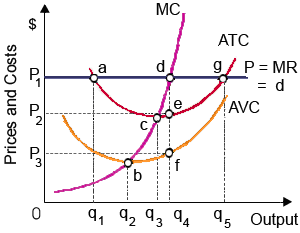
2102_Total Revenue1.png

Can anybody suggest me the proper explanation for given problem regarding Economics generally?

   Related Questions in Microeconomics

  • Q : Inequality of Income in Loren Curve A

    A Lorenz curve which is more bowed away from a 45 degree line indicates larger: (w) degrees of economic competition. (x) success for anti poverty programs. (y) equality of income. (z) inequality of income. How can

  • Q : Price ceiling set below equilibrium A

    A price ceiling set below equilibrium will raise the: (w) quantity supplied. (x) good’s opportunity cost to buyers. (y) sellers’ profits. (z) rate of excess supply. How can I solve my economics

  • Q : Quantity supply or demand to changes in

    When a measure of the responsiveness of one variable to other (for example, quantity supplied [or demanded] to changes within price), elasticity: (w) provides no criterion for identifying responsiveness. (x) depends on the units used to express change

  • Q : Comparative Advantage in opportunity

    The most important declines in opportunity costs of multiple goods for the consumers and greatest rises in the value of net production for all societies everywhere tend to be realized whenever production is organized in accord by: (1) The optimal clas

  • Q : Maximize profits with producing demand

    An imperfectly competitive firm can’t maximize its profits through producing where demand is: (w) elastic. (x) unitarily elastic. (y) inelastic. (z) downward sloping. Can someone explain/help me with best sol

  • Q : Effect of reducing prices on

    Can someone help me in finding out the accurate answer from the given options. People tend to recognize more ways to employ a good if the: (1) The prices of substitute goods drop. (2) Good is poorer and their incomes increase. (3) Complements of good become more costl

  • Q : Principle of equal marginal utilities

    The thought that, in equilibrium, the more you pay for the good, more it is worth (that is, at the margin) to you is most intimately associated to the: (1) Law of diminishing returns. (2) Equivalent satisfaction corollary. (3) Veblen effect. (4) Rising cost hypothesis

  • Q : Seller in a monopoly market structure A

    A monopoly is a type of market structure in that one: (w) seller makes up the industry. (x) giant firm is a price taker. (y) barrier to entry exists. (z) giant firm is the particular buyer of resources.

    Q : Difference among change in

    The difference between change in supply and change in quantity supplied is as follows: (1) The change in quantity supplied is caused just by the change in the price of good, whereas a change in supply takes place whenever the ceteris paribus suppositi

  • Q : Total variable cost By refering the

    By refering the following data give the answer of this question . The total variable cost of producing 5 units is: A) $61. B) $48.  C) $37. D) $24. </span