--%>

Maximum economic profit operates in new competitive firm

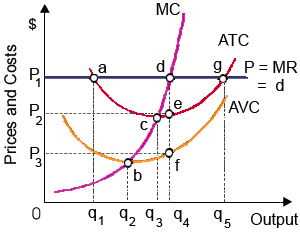
When this competitive firm operates at point d in demonstrated graph, in that case this: (w) could increase profits by expanding output to q5. (x) maximizes economic profit [ as area P2P1de], but these profits will evaporate in the long run as new firms enter the industry. (y) minimizes economic losses, that equal area P3P2ef. (z) experiences total fixed costs equal to area OP1dq4.
2452_Total Revenue1.png

Can someone explain/help me with best solution about problem of Economics...

   Related Questions in Microeconomics

  • Q : Requirements for pure competition The

    The needs for pure competition are most intimately met by the market for: (i) domestic (American) steel. (ii) comic books. (iii) sugar-coated cereal within your local grocery store. (iv) stocks and bonds traded on Wall Street after they have been issu

  • Q : Firm under perfect competition The firm

    The firm beneath perfect competition is a price taker by the reasons shown below:A) Number of firms: The number of firms beneath perfect competition is so big that no individual firm by changing sale, can cause an

  • Q : Determine total costs by

    Hey guys I need your idea for this query regarding the total costs as illustrated graph that this profit-maximizing pure competitor’s total cost (TC) equals area as: (w) 0Phq2. (x) 0bgq2. (y) 0aeq1. (z) daef.

    Q : Interdependent economy I am facing

    I am facing problem in this question. Help me in find out correct answer of this economic based question. Explain interdependent economy?  Illustrate it by using an input-output table and model.

  • Q : Problem regarding to Subsidy Wedges The

    The demand for an undergraduate college education would rise from the perspective of college administrators when: (w) the federal government started paying half of the interest charged upon student loans. (x) grade inflation was reversed and the average grade earned b

  • Q : Marginal Benefits The marginal

    The marginal advantage/profit to you of a usual activity in which you engage tends to: (i) Raise as long as you enjoy the activity. (ii) Eventually reduce as you do more of activity. (iii) Stabilize when the market price of doing the activity stay constant. (iv) Impro

  • Q : Price elasticities for market demand

    Of the given price elasticities [ed] for market demand curves, there the one which is absolutely implausible by the vantage of standard economic theory would be one for that, across all conceivable ranges of prices: (1) ed= 0 and the

  • Q : Automation and Wage Rates I have a

    I have a problem in economics on Automation and Wage Rates. Please help me in the given question. When physical capital becomes cheaper: (i) Some of the workers might be displaced however worker productivity as a rule rises.  (ii) Automation will

  • Q : Analytic Time-The Market Immediate The

    The analytical period of time is very short that the firm could not adjust output by hiring more or less of a variable resource was recognized by Alfred Marshall as: (1) Immediate or market period. (2) Long run. (3) Short run. (4) Technological or temporal long run.

  • Q : Falling probably interest rate The

    The interest rate will probably fall when households decide to: (w) consume more currently, shrinking the loanable funds obtainable for business investments. (x) buy new homes in place of restoring their old ones. (y) increase the liquidity of their a