--%>

Maximizing profit regardless magnitude of variable costs

Assume that Monsieur Cournot cannot price discriminate although is intent on maximizing profit. Apart from of the magnitude of variable costs, Cournot would certainly not try to sell: (w) the output corresponding to point b. (x) more than 6,000 liters of water per period. (y) at a price lower than his average fixed costs. (z) the output consequent to point c.
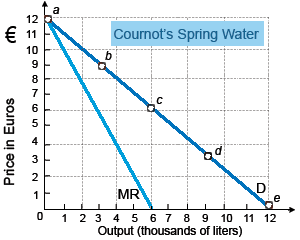
1435_Elasticity and Total Revenue.png

I need a good answer on the topic of Economics problems. Please give me your suggestion for the same by using above options.

   Related Questions in Microeconomics

  • Q : Capital Goods In the above diagram, the

    In the above diagram, the elimination of discrimination is best represented by

  • Q : Price discriminate maximizes joint

    When a successful cartel which cannot price discriminate maximizes the joint profits of its members: (1) the marginal social benefits of additional output exceed the marginal social costs of output. (2) this is impossible for any consumer to gain with

  • Q : Supply in short-run equilibrium When a

    When a purely competitive industry is within short-run equilibrium, this: (w) should also be in long-run equilibrium. (x) won’t be in long-run equilibrium. (y) may or may not be within long-run equilibrium. (z) will experience m

  • Q : Legal constraints in Labor Markets The

    The employer can legally pursue a policy of: (i) Wage discrimination which is based on the race or gender. (ii) Closed shop agreements with the unions. (iii) Firing the workers who join union. (iv) Wage discrimination mainly based on the employee’s seniority. (v

  • Q : Properties of indifference curves

    Properties of indifference curves: The 3 properties of indifference curves are as shown below:A) Slopes downward from left to right: To consume more of onegood the consumer should give up li

  • Q : Market Price in intervention Let’s take

    Let’s take a perfectly competitive market in which the market demand curve is provided by Qd = 20 − 2Pd and the market supply curve is provided by Qs = 2Ps. a) Determine the e

  • Q : Purely competitive market and constant

    When this firm is typical in illustrated figure of this purely competitive market and when this is a constant-cost industry, in that case the long run supply curve for the industry is a horizontal line which would go from: (1) point c

  • Q : Demand Curve when price is cut I have a

    I have a problem in economics on Demand Curve when price is cut. Please help me in the following question. When the price of Snapple is cut, then: (1) The lower quantity of Snapple is demanded. (2) A bigger quantity of Snapple is demanded. (3) Demand for the Snapple r

  • Q : Production in a competitive market

    Production within a competitive market system tends to be: (1) a process that exploits labor to the maximum. (2) geared to respond to the whims of central planners. (3) relatively efficient and low cost. (4) highly automated because labor costs more t

  • Q : Break-even level of income under

    For a family of four the break-even level of income under the negative income tax system demonstrated in this figure is: (1) $15,000 per year. (2) $30,000 per year. (3) $45,000 per year. (4) $60,000 per year. (5) $75,000 per year.