--%>

Maximizes profit in production of product

When Robomatic Corporation maximizes profit in its production of RoboMaids, its monthly total revenue will be roughly: (i) $100 million. (ii) $140 million. (iii) $160 million. (iv) $200 million. (v) $240 million.
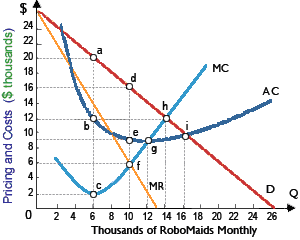
1895_Elasticity and profit.png

Can anybody suggest me the proper explanation for given problem regarding Economics generally?

   Related Questions in Microeconomics

  • Q : Economic profits maximizing When this

    When this monopolistic competitor produces Q units, this is maximizing: (w) sales development and its market share. (x) total revenue. (y) economic profits. (z) total fixed cost and its managers' salaries.

  • Q : Marginal resource cost for a monopsonist

    Can someone help me in finding out the right answer from the given options. The marginal resource cost for the monopsonist in labor market which can’t wage discriminate: (i) Is perfectly elastic. (ii) Lies above the market supply of labor. (iii) Is perfectly ine

  • Q : Monopolistic-Exploitation problem In

    In equilibrium for the price maker firm, the rate of monopolistic exploitation is the difference between: (i) P and MR. (ii) P and MC. (iii) Total revenue and net cost per unit of output. (iv) Output price and rate of monopsonistic exploitation. (v) VMP and MRP.

  • Q : Earn zero economic profit by

    When a monopolistic competitor is earning zero economic profit, in that case this: (1) sells at a price equal to average total cost. (2) sells at a price equal to marginal cost. (3) is at the minimum point on its average total cost cu

  • Q : Change in total revenue by selling

    Marginal revenue, which is: (w) the change in total revenue from selling an additional unit of output. (x) the change in total revenue from hiring an additional unit of labor. (y) computed as TR/Q. (z) specified by change in Q / change in TR.

  • Q : Price elasticity of demand coefficient

    In this demonstrated figure, there the price elasticity of demand coefficient is: (1) one at the midpoint. (2) greater than one in range a. (3) less than one in range b. (4) falling along with movements down along the demand curve. (5) All of the abov

  • Q : Labor Union History problem Can someone

    Can someone please help me in finding out the accurate answer from the following question. The labor unions have tended to be most successful in the organizing: (1) Blue collar workers. (2) Clerical workers. (3) Professionals. (4) White collar workers.

  • Q : Positively-sloped supply curve

    A straight-line, which positively-sloped supply curve which starts from the quantity axis is: (w) elastic for all prices and quantities. (x) inelastic for all prices and quantities. (y) unitarily elastic for all prices and quantities. (z) a sign that

  • Q : Problem on Elasticity formula Whenever

    Whenever the price of plastic moose heads increase from $5 to $7, monthly sales fall from 2000 to 1000 units. By using the arc elasticity formula, the price elasticity of demand will be: (i) 3.0. (ii) 1/3. (iii) 2.0. (iv) 2.5.

    Q : Shifting supply of curve by entry of

    When the price for Christmas trees is initially P1, in that case in the long run: (w) firms will neither enter nor exit this industry. (x) entry of firms will shift curve supply curve A to the right. (y) exit of firms will shift supply curve A to the left.