--%>

Maximized profit of purely-competitive lumber mill

Profit is maximized as in illustrated graph when this purely-competitive lumber mill produces at: (1) point a. (2) point b. (3) point c. (4) point d. (5) point e.
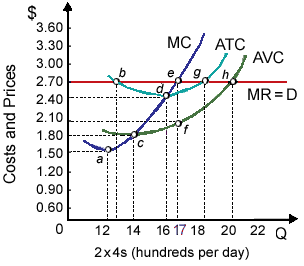
1784_Profit Maximization.png

Hello guys I want your advice. Please recommend some views for above Economics problems.

   Related Questions in Microeconomics

  • Q : Raising prices raises total costs for

    Total revenue at your fried hushpuppy stand has been declining currently. Your partner persevere that increasing hushpuppy prices will increase total revenue, although you believe only as fervently which lowering prices will produce more total revenue

  • Q : Additional Funds for Breaking Invention

    If Bank of America helps link an inventor in require of additional funds to develop a ground breaking invention along with a retired school teacher along with excess savings, in that case they are performing: (1) love connections. (2) financial interm

  • Q : Demand curve facing monopolistically

    The demand curve that facing a monopolistically competitive firm is: (1) perfectly elastic within the short run. (2) perfectly inelastic due to numerous substitutes for its product. (3) less elastic than the demand curve facing a comp

  • Q : Marginal resource cost of labor For a

    For a gain maximizing competitive firm operating in the competitive labor market, the: (1) Marginal resource cost of the labor is similar to the wage rate. (2) Supply of the labor is perfectly inelastic. (3) Production quota is precisely proportional to the labor hire

  • Q : Words of Joseph A. Schumpeter about

    Joseph A. Schumpeter popularized and refined the concept that profits: (i) ultimately derive primarily from innovation. (ii) are necessary compensation to entrepreneurs for bearing uncertainty. (iii) are reduced by bureaucratic inefficiencies in firms

  • Q : High economic profits High economic

    High economic profits for firms are least probable to arise by: (1) important market power. (2) “cut-throat” competitive pricing policies. (3) superior products. (4) unusually efficient managers. (5) price-maker behavior.

    Q : Legal constraints in Labor Markets The

    The employer can legally pursue a policy of: (i) Wage discrimination which is based on the race or gender. (ii) Closed shop agreements with the unions. (iii) Firing the workers who join union. (iv) Wage discrimination mainly based on the employee’s seniority. (v

  • Q : Collective bargaining agreements Tell

    Tell me the answer of this question. Collective bargaining agreements cover: A) wages and hours. B) union status. C) seniority and job opportunities. D) all of the above.

  • Q : Changes in supply of loanable funds The

    The supply of loanable funds changes positively along with the: (w) willingness of people to defer consumption in the future. (x) profitability and productivity of new capital investments. (y) price of the output about new capital will produce. (z) fu

  • Q : Experience of mill for constant cost

    When generic lumber processing is a constant cost industry, within the long run this lumber mill is probable to experience a: (i) a severe shrinking of economic profit to zero. (ii) a decline within the price of 2×4s to about $2.40 apiece. (iii)