--%>

Maximize profit by marginal revenue and costs

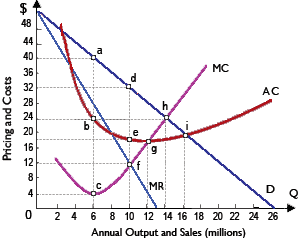
Prohibition Corporation’s very famous St. Valentine’s Day software is going within version 6. The very first point Prohibition requires to classify in its quest to maximize profit is the: (1) point e. (2) point f. (3) point g. (4) point h. (5) point i.
1999_software of Elasticity.png

Hey friends please give your opinion for the problem of Economics that is given above.

   Related Questions in Microeconomics

  • Q : Legal barriers to entry in a market

    Governmentally-imposed obstacles to the entrance of new firms within a market are termed as: (1) regulatory barriers or legal barriers to entry. (2) strategic barriers to entry. (3) natural barriers to entry. (4) tax barriers to entry. (5) revenue blockades.

  • Q : Annuity of the Perpetuity Dividing the

    Dividing the annuity of the perpetuity by the interest rate gives in the perpetuity’s: (w) rate of return. (x) present value. (y) internal rate of discount. (z) capitalization rate. Can someo

  • Q : Law of Income Distribution by Pareto

    The theorist who asserted as, “When you redistributed the world’s income and wealth equally across the whole population, eighty percent of this would be back within the hands of the population’s top 20% in twenty years,” which

  • Q : Output From the heterodox approach,

    From the heterodox approach, what options does the enterprise need to produce more output? What effect do these options put on its cost structure?

  • Q : Get economic profit by economic rent

    When you quickly attain economic profit because you build a store on rented land which turns out to be located conveniently for potential customers, in that case: (w) profit will increase when you buy the land after your lease expires. (x) rent will a

  • Q : Normal profit Normal profit signifies

    Normal profit signifies zero economic profit. Explain why?

  • Q : Total sales revenues and price

    If the price falls, there total sales revenues rise, in that case the price elasticity of demand: (1) relatively elastic. (2) relatively inelastic. (3) unitary elastic. (4) zero elastic. (5) inflexibly marginal.

    Q : Price elasticities of demand and higher

    Price elasticities of demand tend to as: (i) fall as higher prices are charged. (ii) rise as higher prices are charged. (iii) almost always be constant. (iv) not be associated to the length of time. (v) not be influenced by price changes.

  • Q : Present Value of Annual Interest Rate

    When the annual interest rate is 11 percent and a small office building can be expected to lease perpetually for price of $33,000 annually, the building and also the land it sits onto have a present value of approximately: (1) $363,00

  • Q : Long-run economic losses in a

    Expectations of long-run economic losses within a competitive industry as: (1) inevitably follow “cut throat” pricing policies. (2) cause firms to leave the industry. (3) increase each firm’s long-run fixed costs. (4) create pressure