--%>

Market shifting in equilibrium

When market begins in equilibrium at point e upon S0D0 and in that case young American families increasingly "inherit" furniture like their baby-boomer parents move within smaller retirement homes, that market will tend to shift in the direction of: (1) point i. (2) point h. (3) point a. (4) point d. (5) point f.
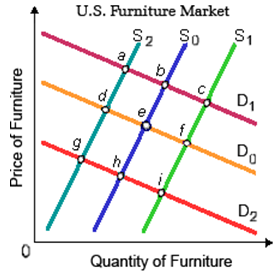
1001_Market shifting in equilibrium.png

How can I solve my economics problem? Please suggest me the correct answer.

   Related Questions in Microeconomics

  • Q : Dilemma model of prisoner When the

    When the Kroger grocery chain raises the price of Starbuck’s Frappuccino, in that case Safeway will remain its price the same. Although, if Kroger drops the price of Frappuccino, then Safeway will match the price cut. This kind of behavior conforms to the: (1) s

  • Q : Elasticity of Supply Elasticity of

    Elasticity of Supply: The law of supply states us that quantity supplied will react to a modification in price. The notion of elasticity of supply elucidates the rat

  • Q : Economic project Hello, Would you

    Hello, Would you please find a project in managerial economic in the attachment. Please tell me in which price you will be solve it and when you complete it? NOTE: I attach tow files (one is the project and another as the sample for it) I choose Starbucks company for the project. A Special N

  • Q : Labor Supply Curves to the Competitive

    The price taker in labor market: (1) Can set the salary that it will pay for the labor it hires. (2) Can set the salary at which it supplies the use of its labor. (3) Doesn’t care what salary it pays or obtains. (4) Can’t influence the wage recognized by t

  • Q : Founder of Utilitarianism I have a

    I have a problem in economics on Founder of Utilitarianism. Please help me in the following question. The utilitarianism founder in England was: (i) Rupert Brooke. (ii) Jeremy Bentham. (iii) Thomas Dewey. (iv) John Stuart Mill. (v) Adam Smith.

    Q : Constant cost industry of production

    When Del’s production function and costs are characteristic for wheat farmers and when wheat farming is a constant cost industry, in that case in the long run, there the price of wheat will be: (i) $4 per bushel. (ii) $6 per bushel. (iii) $8 per

  • Q : Domestic production possibilities curve

    Refer to the following domestic production possibilities curve for Karalex. The gain to Karalex from specialization and international trade is represented by a move from: 1) A to B. 2) C to A. 3) C to D. 4) B to E.

    Q : Prices of resources in constant cost

    When industry expansion or contraction does not influence the prices of resources used through its firms, then the industry tends to experience: (w) increasing costs. (x) constant costs. (y) decreasing costs. (z) diseconomies of scale.

    Q : Problem Bilateral Monopoly The word

    The word economists employ to explain a condition where a powerful seller confronts the powerful buyer is: (1) Reciprocal exploitation. (2) Strategic bloc management. (3) Dialectical bargaining. (4) Ancillary reciprocity. (5) Bilateral monopoly.

    Q : Expected rate of return on R&D

    All of the following rise the expected rate of return on R&D expenditures, except: A) patents. B) trademarks. C) imitation by others. D) trade secrets