--%>

Market shift when exporting

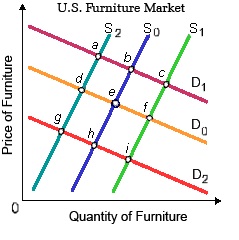
When the U.S. furniture market is primarily in equilibrium at point e on S0D0 and then Chinese manufacturers start exporting more furniture to the United States, then this market would shift towards a new equilibrium at: (1) point a. (2) point b. (3) point c. (4) point d. (5) point f.
884_5.jpg

Can someone help me in getting through this problem.

   Related Questions in Macroeconomics

  • Q : Value of the net benefits Whenever

    Whenever consumers paid an amount for water which reflects the value of the net benefits they obtain from consuming it, water would outcome: (1) Maximum consumer excess. (2) Zero consumer excess. (3) Total revenue equivalent to variable cost. (4) Zero

  • Q : Explain Shut Down Price Explain the

    Explain the term Shut Down Price? Illustrate it.

  • Q : Principles of macroeconomics What are

    What are the “powers of the Federal Reserve

  • Q : Difference between

    Elucidate the differences among the frictional, structural, and cyclical forms of unemployment.

  • Q : Transactions demand for money The basic

    The basic determinant of the transactions demand for money is the

  • Q : Price elasticity of demand for DVD games

    In this figure shown below, the price elasticity of demand for DVD games among prices of $30 and $40 is nearest to: (i) 7/6. (ii) 1/2. (iii) 3/7. (iv) 7/3. (v) 1/3.

    Q : Problem related to rising GDP Between

    Between 1961 and 2007, the rising share of the Canadian population in paid employment contributed to rising GDP per person. But suppose that the share of the Canadian population in paid employment had remained constant between 1961 and 2007. What would Canadian GDP pe

  • Q : IS-KM Model with classical supply

    discuss with the help of IS-LM model why money has no effect on output in classical supply case

  • Q : Difference between APC and MPC

    Differentiate between APC and MPC. The value of which of them can be greater than another and when? Answer: APC is the average

  • Q : Explain about the marginalism theory

    Most economists believe such that people increase an activity when they perceive the expected additional benefits as exceeding the expected extra cost, but decrease their level of an activity whenever they believe the benefits from the last few units of the activity a