--%>

Market in equilibrium point by interest rate

When this market is primarily in equilibrium at point c, any drop within interest rates caused through an increase in people’s willingness to save will cause as: (1) the rate of return schedule reflected into I0 to shift to the right. (2) the rate of return schedule reflected into I0 to shift to the left. (3) a movement down the rate of return schedule by point c to point e. (4) a movement up the rate of return schedule from point c to point a. (5) households to raise their saving.
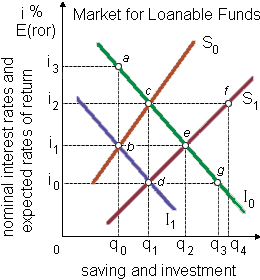
1987_Problem on Loanable Funds.png

Hello guys I want your advice. Please recommend some views for above Economics problems.

   Related Questions in Microeconomics

  • Q : Form of Discrimination The form of

    The form of discrimination which probably causes the smallest problems for income distribution is: (1) occupational discrimination. (2) human capital discrimination. (3) price discrimination. (4) personal discrimination. (5) employment discrimination.

  • Q : Product differentiation in gain

    Monopolistic competitors: (1) base decisions on the anticipated reactions of their many individual competitors. (2) can easily enter but not exit industries. (3) may sometimes act like monopolists and gain economic profits in the short run because of

  • Q : Analytic Time-The Market Immediate The

    The analytical period of time is very short that the firm could not adjust output by hiring more or less of a variable resource was recognized by Alfred Marshall as: (1) Immediate or market period. (2) Long run. (3) Short run. (4) Technological or temporal long run.

  • Q : Price equality with marginal costs It

    It is not possible for a nondiscriminating, that profit maximizing monopolist to attain equilibrium where MR = MC as well as: (w) economic profit = 0. (x) economic profit is negative. (yz marginal costs are at the minimum of average costs [MC = ATC].

  • Q : Involvement of price makers firms

    Price-maker firms would most likely comprise: (1) a tomato farmer in California. (2) a sheep herder who produces wool in a remote part of New Zealand. (3) a stock broker who contacts customers through the internet. (4) a rural grocery store. (5) the b

  • Q : Marginal Benefits The marginal

    The marginal advantage/profit to you of a usual activity in which you engage tends to: (i) Raise as long as you enjoy the activity. (ii) Eventually reduce as you do more of activity. (iii) Stabilize when the market price of doing the activity stay constant. (iv) Impro

  • Q : Problem on Marginal resource costs Can

    Can someone help me in finding out the right answer from the given options. The synonymous words marginal factor costs or the marginal resource costs signify to the: (i) Cost incurred in generating an additional unit of capital. (ii) Cost to the resource owner of secu

  • Q : Higher price at slope of the demand

    When the slope of the demand for wheat is ten, we can predict now that a higher price of wheat will be as: (w) increase total expenditures on wheat. (x) reduce total expenditures on wheat. (y) not influence total expenditures on wheat. (z) More information is required

  • Q : Asymmetric Information problem The

    The one-year old car tends to sell for much less than the brand latest car. A part of the reason is that: (i) Sellers and buyers have similar information regarding used cars as they do latest cars. (ii) Buyers and sellers both encompass more information regarding new

  • Q : Marginal social benefit and costs under

    Under pure competition, there is marginal social benefit will equivalent marginal social cost unless: (w) “hit and run” entrepreneurs prosper. (x) economic profits are zero. (y) there are externalities. (z) entrepreneurs a