--%>

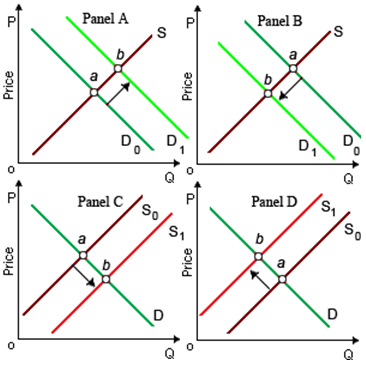
Equilibrium moves market increase in supply

When equilibrium moves from point a to point b, the simple market experiencing a raise in supply is demonstrated within: (w) Panel A. (x) Panel B. (y) Panel C. (z) Panel D.
606_Supply and Demand.png

Hello guys I want your advice. Please recommend some views for above economics problems.

   Related Questions in Microeconomics

  • Q : Higher interest rate in saving and

    A higher interest rate shows a: (w) stronger preference for current income over future income. (x) weaker preference for current income over future income. (y) stronger preference for future income over current income. (z) wave of pessimism among inve

  • Q : Practicing for predatory pricing A firm

    A firm which practices predatory pricing as: (w) tends to incur short-run losses greater than its rival. (x) lowers its price to drive out its rival and then keeps the price low to discourage extra entry. (y) will sell similar amount of output as when

  • Q : Relevant demand of Kinked Demand by

    In this demonstrated figure kinked demand curve model, when a firm at point a raises or lowers its price and the rest of the firms in the industry do similar thing, in that case the relevant demand curve for the firm is: (w) demand curve D0

  • Q : Exceeds marginal revenue curve by

    That this firm can’t successfully price discriminate is most strongly indicated through the fact that: (1) the linear demand curve exceeds the marginal revenue curve for all outputs shown. (2) MR = MC maximizes profit. (3) total revenue total co

  • Q : Incentives given by higher interest rate

    Higher interest rates give incentives for: (w) a corporation to build a new plant. (x) a family to save more. (y) a family to buy a new house. (z) automakers to produce more new cars. Please choose the right answer

  • Q : Market interest rates for different

    Market interest rates for different financial assets are positively associated to the: (w) expected rate of inflation. (x) liquidity of the assets. (y) efficiency of financial intermediation. (z) preferences of people about consuming in the future ins

  • Q : Oligopolistic pricing behavior

    Collusive oligopolistic pricing behavior: (1) leads to natural monopoly when only some firms dominate an industry. (2) entails overt agreement among many firms in setting outputs and prices. (3) arises while contestable firms simultaneously raise or l

  • Q : Problem on Minimum Wage Sec. A :The

    Sec. A:The Bureau of Labor Statistics of a small state has asked you to analyze a minimum wage policy to support unskilled workers in the State’s local economy, which is still suffering from the effects of the recession.  Based on

  • Q : Inverse relationship in Law of Demand

    The law of demand signifies to: (i) The direct relationship accessible between quantity and prices demanded. (ii) The inverse relationship accessible between quantity demanded and opportunity cost. (iii) How demand shifts due to modifications in price

  • Q : Marginal social benefits of products If

    If an oligopoly achieves equilibrium, in that case the marginal social: (w) benefits of their products exceed the marginal social costs. (x) cost of their product exceeds the marginal social benefit. (y) benefits equal the marginal so