--%>

Market demand with market power

LoCalLoCarbo has turn into the favorite of fad dieters. There in illustrated graph curve B shows: (i) LoCalLoCarbo’s marginal cost curve. (ii) LoCalLoCarbo’s average variable cost curve. (iii) LoCalLoCarbo’s average total cost curve. (iv) the market demand curve facing LoCalLoCarbo. (v) LoCalLoCarbo’s marginal revenue curve.
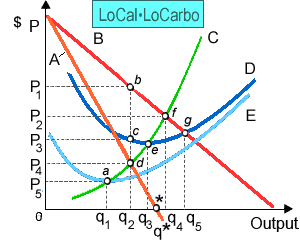
531_Market Power and Marginal Revenue.png

Can anybody suggest me the proper explanation for given problem regarding Economics generally?

   Related Questions in Microeconomics

  • Q : Commercial introduction of production

    Innovation: (w) entails financial investment to create human capital. (x) comprises the commercial introduction of a new product or production process. (y) can reasonably describe only normal accounting profit. (z) was used by John Maynard Keynes to d

  • Q : Form of Discrimination The form of

    The form of discrimination which probably causes the smallest problems for income distribution is: (1) occupational discrimination. (2) human capital discrimination. (3) price discrimination. (4) personal discrimination. (5) employment discrimination.

  • Q : Long-term effects of the Baby Boom What

    What will be the long-term effects of the Baby Boom?

  • Q : Price charging by minimizing average

    See a monopolist which cannot price discriminate but that maximizes profit. When this firm produces the level of output where is average cost at its minimum that will charge a price: (i) equal to marginal cost and generate zero economic profit. (ii) e

  • Q : Annual total costs of production When

    When Prohibition Corporation maximizes profit into its production of St. Valentine’s Day software, there annual total costs of it will be around: (1) $180 million. (2) $140 million. (3) $100 million. (4) $80 million. (5) $40 mil

  • Q : Problem on Labor Unions and Wages The

    The Industrial unions try to accomplish wage rates above the competitive level through: (i) Limiting the supply of labor to the industry. (ii) Raising the supply of labor. (iii) Raising the productivity of the labor in an industry. (iv) Member’s agreeing to work

  • Q : Production in a competitive market

    Production within a competitive market system tends to be: (1) a process that exploits labor to the maximum. (2) geared to respond to the whims of central planners. (3) relatively efficient and low cost. (4) highly automated because labor costs more t

  • Q : Nominal Interest Rates Nominal interest

    Nominal interest rates are: (w) always identical to real interest rates. (x) the percentage of monetary premiums paid per time era for the use of money. (y) determined by the size of economic rents. (z) the percentage of purchasing power transferred b

  • Q : Calculating accounting profits The firm

    The firm has $70,000 in implicit costs, and the economic profit of $40,000. This firm’s: (i) Explicit cost equivalent $30,000. (ii) Accounting profits equivalent $110,000. (iii) Normal gain equivalents $40,000. (iv) Explicit costs equivalent $110,000.

  • Q : Equality between marginal revenue and

    A profit-maximizing monopolist which does not price discriminate and that faces a demand curve that is higher at some output levels than is the firm’s average variable cost curve finds out price and quantity where: (w) profit pe