--%>

Market adjustments through a scarce good

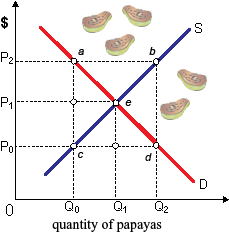
Within below figure there is market for papayas: (1) a shortage exists at P2. (2) papayas are a free good at P0. (3) papayas are currently a scarce good. (4) consumer's demand prices equivalent P2 at quantity Q2. (5) the equilibrium price for papayas is P0.
2453_example of Price Floors.png

How can I solve my economics problem? Please suggest me the correct answer.

   Related Questions in Microeconomics

  • Q : Maximum possible total revenue from

    Maximum possible total revenue by sales of the extremely popular St. Valentine’s Day software is about: (i) $65 million. (ii) $45 million. (iii) $85 million. (iv) $105 million. (v) $200 million.

    Q : Problem related to aggregate demand

    Refer to the below diagram, in which Qf is the full-employment output. If aggregate demand curve AD1 describes the current situation, appropriate fiscal policy would be to: A) increase taxes and reduce government spending to shift the aggregate d

  • Q : Negative externalities Give the answer

    Give the answer of following question. Negative externalities arise: A) when firms pay more than the opportunity cost of resources. B) when the demand curve for a product is located too far to the left. C) when firms "use" resources without being compelled to pay for

  • Q : What is involuntary unemployment What

    What is involuntary unemployment: The people who are willing to work at given wage rate do not obtain work.

  • Q : Price increases and price cut in

    Within the kinked-demand-curve model, there the firm faces: (w) a less elastic demand curve for price increases as well as a more elastic demand curve for price cuts. (x) a more elastic demand curve for price increases and a less elastic demand curve

  • Q : Principle of equal marginal utilities

    The thought that, in equilibrium, the more you pay for the good, more it is worth (that is, at the margin) to you is most intimately associated to the: (1) Law of diminishing returns. (2) Equivalent satisfaction corollary. (3) Veblen effect. (4) Rising cost hypothesis

  • Q : Price elasticity of demand coefficient

    In this demonstrated figure, there the price elasticity of demand coefficient is: (1) one at the midpoint. (2) greater than one in range a. (3) less than one in range b. (4) falling along with movements down along the demand curve. (5) All of the abov

  • Q : Compute price elasticity At price of

    At price of Rs. 20 the unit quantity demanded is 300 units. Its price downs by 10% its quantity demanded rises by 60 units. Compute price elasticity. Answer: <

  • Q : How production increases the value of

    I have a problem in economics on how production increases the value of good. Please help me in the following question. The production of jewelry from valuable metals raises the value of a good by modifying its: (1) Time. (2) Possession. (3) Place. (4) Form.

  • Q : Consequence of Rational Ignorance Can

    Can someone help me in finding out the right answer from the given options. Being disappointed whenever you finally learn how some desserts are accessible after you have already told the server at a restaurant that you will try the ‘all-you-can-eat’ buffet