--%>

Market adjustments primarily in equilibrium condition

When the U.S. furniture market is primarily in equilibrium at point e upon S0D0 and in that case Chinese manufacturers begin exporting more furniture to the United States, that market would move in the direction of a new equilibrium at: (1) point a. (2) point b. (3) point c. (4) point d. (5) point f.
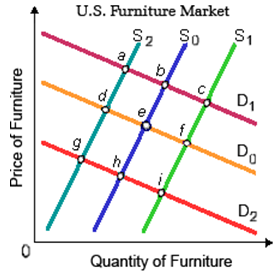
1498_Market shifting in equilibrium.png

Can anybody suggest me the proper explanation for given problem regarding Economics generally?

   Related Questions in Microeconomics

  • Q : Market demands for automobiles The

    The market demands for automobiles are not rapidly and directly influenced by modifications in: (i) Income. (ii) Gasoline prices. (iii) Salaries paid to auto-workers. (iv) The number of legal drivers. (v) Preferences and tastes.

    Q : Problem on numbers of Buyers Even when

    Even when each household’s demand curve didn’t shift, the market demand for the butter would increase if there were a raise in: (1) House-hold income. (2) People’s preferences for the butter. (3) Population. (4) Price of margarine.

  • Q : Illustrate an example of arbitrage

    Purchasing oil into Kuwait for $22 per barrel and selling that you purchased for $30 per barrel into Sao Paolo is an illustration of: (w) speculation. (x) bifurcation. (y) a subsidy. (z) arbitrage. I need a good answer on the topic

  • Q : Demand of a competitive firm The

    The competitive firm will demand more labor when: (i) Technological advances support automation. (ii) The price of firm's output increases. (iii) More firms enter in the industry. (iv) The value of marginal product is beneath the wage rate. (v) Worker

  • Q : Determine relatively price elasticity

    A price elasticity of demand of 2.0 implies that at that point, the demand curve is: (w) income elastic. (x) relatively price elastic. (y) relatively price inelastic. (z) unitarily price elastic. I need a good answ

  • Q : Maximum negatively-sloped demand curve

    The total revenue of a firm which faces a negatively-sloped demand curve: (w) is at a maximum where marginal revenue is zero. (x) declines while average revenue falls as output grows. (y) rises at an increasing rate over the output range plagued throu

  • Q : Unexpected growth of inventories Can

    Can someone help me in finding out the right answer from the given options. Whenever the quantity of a good supplied surpasses the quantity demanded: (i) Unexpected growth of inventories will cause prices to drop. (ii) The present market price is beneath equilibrium.

  • Q : Wage Discrimination-supply labor curve

    The employer with monopsony power which as well had the capability to wage discriminate perfectly would confront the marginal factor cost of the labor curve: (i) Similar to the supply of labor curve it faces. (ii) Lower than the supply of labor curve it faces. (iii) H

  • Q : Immobility of Labor-Monopsony Power I

    I have a problem in economics on Monopsony Power and Immobility of Labor. Please help me in the given question. The immobility of labor is economically significant as: (1) Most of the people like to move, however can't. (2) People in high salary occupations won't be c

  • Q : Negative marginal revenue Monopolies

    Monopolies will not function in the inelastic portion of the demand curves they face since: (w) marginal revenue is negative. (x) total revenues are negative. (y) total revenue falls as less is produced. (z) marginal revenue is always greater than mar