--%>

Marginal tax rate under negative income tax

The marginal tax rate upon earned income under negative income tax system demonstrated in this figure is: (1) 15 percent. (2) 20 percent. (3) 25 percent. (4) 33.3 percent. (5) 50 percent.
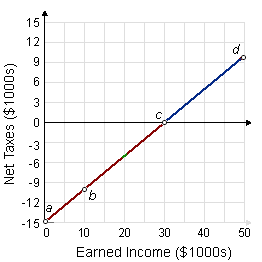
1395_Negative Income Tax Problem.png

Hello guys I want your advice. Please recommend some views for above Economics problems.

   Related Questions in Microeconomics

  • Q : Problem on relative monetary values The

    The relative monetary values an individual consumer subjectively puts on containing a bit more or less of a good are termed as: (i) Consumer preferences. (ii) Demand prices. (iii) Psychic prices. (iv) Subliminal prices. (v) Consumer utilities.

  • Q : Instance of Adverse Selection Nutcake

    Nutcake Products hires new staffs devoid of revealing that the rising demand for nutcakes and partial staffing make it not possible for staffs to take their guaranteed 2-week vacations. Nut cake’s shortage of candor is most unambiguously an instance of: (1) Symm

  • Q : Persistence of Economic profits in long

    I have a problem in economics on Persistence of Economic profits in long run. Please help me in the following question. Economic profits will continue in long run only when: (i) There are barriers to the entry and exit. (ii) Markets are much competitive. (iii) There a

  • Q : Tourism effects How tourism effects in

    How tourism effects in an upcoming industry?

  • Q : Discounted present value of future net

    A fundamental principle of finance is that the value of any of investment is: (w) the discounted present value of all future net cash flows expected by the investment. (x) negatively related to the future net cash flows generated from the investment. (y) the sum of al

  • Q : Supply of bonds for demand for loanable

    An increase in the supply of bonds tends to: (1) reduce the interest rate. (2) occur simultaneously with an increase in the demand for loanable funds. (3) yield an increase gross investment but a decrease in net investment. (4) drive up the prices of

  • Q : Higher interest rate in saving and

    A higher interest rate shows a: (w) stronger preference for current income over future income. (x) weaker preference for current income over future income. (y) stronger preference for future income over current income. (z) wave of pessimism among inve

  • Q : Problem on average retail price and the

    Table indicate the average retail price of milk and the Consumer Price Index in the year 1980 -1998. 1010_Average</span></p>
                                        </div>
                                        <!-- /comment-box -->
                                    </li>
   
   </td>
	</tr><tr>
		<td>
       
      <li>
                                        <div class=

    Q : Limitation of price elasticities of

    Price elasticities of supply and demand do NOT: (w) reflect desperation for goods and customers by buyers and sellers, respectively. (x) rise as the time period considered is expanded. (y) find out the economic incidence of a tax. (z) find out the leg

  • Q : Earn zero economic profit by

    When a monopolistic competitor is earning zero economic profit, in that case this: (1) sells at a price equal to average total cost. (2) sells at a price equal to marginal cost. (3) is at the minimum point on its average total cost cu