--%>

Marginal social costs exceed the marginal social benefits

When governments compelled pharmaceutical producers to manufacture and sell at least Q3 penicillin, in that case the: (1) purely-competitive firms which produced penicillin would experience persistent economic profits. (2) resulting inadequate antibiotic treatments would leave much disease untreated. (3) marginal social benefits of penicillin would exceed the marginal social costs. (4) loss in social welfare would about equal the area of triangle adf. (5) marginal social costs of penicillin would exceed the marginal social benefits.
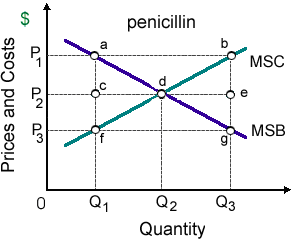
1856_Efficiency and Welfare.png

Hey friends please give your opinion for the problem of Economics that is given above.

   Related Questions in Microeconomics

  • Q : Determine elasticity of demand for

    When the U.S. price elasticity of demand for gasoline is 1.0, the price elasticity of demand for gas sold through one of several gas stations along a busy highway: (w) less than 1.0. (x) 1.0. (y) greater than 1.0. (z) zero.

    Q : Voluntary verses Involuntary Poverty

    When physically and mentally capable individuals who are born in impoverished families fail to work after they develop up but since they can rely on charity, in that case they are experiencing: (1) involuntary poverty. (2) relative poverty. (3) a vicious cycle of pove

  • Q : Problem on Analysis Paralysis Consumers

    Consumers confronting huge arrays of choices whenever they contemplate choosing one brand of toothpaste out of 50, or whether to purchase pulp-free, not-from-concentrate orange juice, calcium-fortified, or the extra-pulp, non-calcified, from-concentrate version, frequ

  • Q : Determine the yearly total revenues

    When the U.S. wheat market as in below demonstrated graph is primarily within equilibrium on S0D0, in that case the yearly total revenues (price × quantity) of wheat farmers will equivalent: (1) 0P4gQ4

  • Q : Measurement of price cross-elasticity

    Price cross-elasticity of demand measures the virtual responsiveness of the quantity sold of a specified good to a change in the: (w) price of which good. (x) individual's income. (y) sales of another good. (z) price of another good.

    Q : Labor Union Goals economically

    Economically, the labor unions can be thought of as the: (i) encouraging competition between the workers for jobs. (ii) Rising the flexibility of nominal wages. (iii) Attempts to cartelize and unite the individual sellers of labor. (iv) Having a goal of the minimum un

  • Q : Supply in short-run equilibrium When a

    When a purely competitive industry is within short-run equilibrium, this: (w) should also be in long-run equilibrium. (x) won’t be in long-run equilibrium. (y) may or may not be within long-run equilibrium. (z) will experience m

  • Q : Relative profitability and efficiencies

    From around 1890 until 1970 year, the “structure-conduct-performance paradigm” dominated theories concerning how firms behave in various types of markets. Here the word “performance” in this context consider to things as: (i) d

  • Q : Earn income and transfer benefits When

    When a family can earn income and transfer profits of $11,500 by working full time at the minimum wage, and also $12,500 in transfer benefits without working, the family’s net gain through working is: (1) zero. (2) $12,500. (3)

  • Q : Demand and supply An increase in

    An increase in consumer desire for strawberries is most likely to: A) increase the number of strawberry pickers needed by farmers. B) reduce the supply of strawberries. C) reduce the number of people willing to pick strawberries. D) reduce the need for strawberry pic