--%>

Marginal revenue in kinked-demand model

Into this "kinked-demand" model, such firm views the marginal revenue curve this faces as the: (1) linear curve acD2 for all prices. (2) linear curve deMR1 for all prices. (3) nonlinear curve adeMR1. (4) linear marginal revenue curve adMR2.
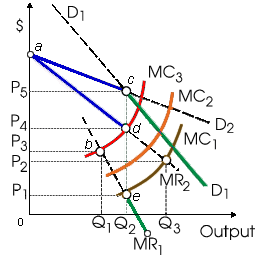
400_Kinked Demand Curve.png

Hello guys I want your advice. Please recommend some views for above Economics problems.

   Related Questions in Microeconomics

  • Q : Function of negative economic profits A

    A function of negative economic profits is to: (w) attract new firms into the industry. (x) keep competition within. (y) signal to other firms to invest their capital into this industry. (z) correct resource allocations by forcing firms generating los

  • Q : Function of Capitalization Winning

    Winning $50,000 yearly for 20 years is similar as winning: (w) $1 million today. (x) less than $1 million today. (y) more than $1 million today. (z) $100 per day, forever. Hello guys I want your advice. Please recommend some views

  • Q : Slope of indifference Curve State the

    State the slope of indifference Curve? Answer: Slope of indifference curve is equivalent to MRS, that is, Marginal Rate of Substitution.

  • Q : DVCs related problem Choose the right

    Choose the right answer from following. Population growth remains high in most DVCs because: A) religious and sociocultural considerations favor large families. B) children may provide economic security for aging parents. C) children provide agricultural labor in rura

  • Q : Substitution effects resulting from

    The Law of Demand mainly relies heavily on the: (1) Buying power consequences of relative price modifications. (2) Substitution effect resultant from the relative price changes. (3) Increase in opportunity costs as income is worn out. (4) Principle of the non satiety.

  • Q : Monopsonist problem I have a problem in

    I have a problem in economics on Resources and Products Flow Model. Please help me in the following question. The firm which is the sole buyer of a specific good or resource is the: (i) Monopsonist. (ii) Conglomerate. (iii) Price discriminator. (iv) P

  • Q : Freedom to enter or leave the market in

    Purely competitive industries are not described by: (i) numerous potential buyers. (ii) product homogeneity. (iii) numerous potential sellers. (iv) freedom to enter or leave the market within the short run. (v) power to adjust quantities although no p

  • Q : Analytic Time-Technological Long Run

    The chronological time needed for the technology to respond to modifications in profit opportunities (that is, the technological long run, also termed as super long run or temporal long run) is: (1) Longer than analytical long run for firm. (2) Shorter than market per

  • Q : Signals to guide production The dollar

    The dollar votes serve to: (i) Offer signals to guide production. (ii) Offer signals to sway govt. policies. (iii) Elect corporate executives. (iv) Elect politicians. Can someone please help me in finding out the accurate answer fr

  • Q : Breaking natural monopoly Breaking a

    Breaking a natural monopoly within a number of competing firms would probably: (w) increase output and lower price to consumers. (x) reduce output and raise price to consumers. (y) reduce efficiency but lower price. (z) have no effect on output or pri