--%>

Marginal revenue curve with marginal power

LoCalLoCarbo has turn into the favorite of fad dieters. There in demonstrated figure curve A shows: (i) LoCalLoCarbo’s marginal cost curve. (ii) LoCalLoCarbo’s average variable cost curve. (iii) LoCalLoCarbo’s average total cost curve. (iv) the market demand curve facing LoCalLoCarbo. (v) LoCalLoCarbo’s marginal revenue curve.
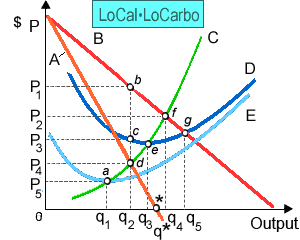
110_Market Power and Marginal Revenue.png

How can I solve my Economics problem? Please suggest me the correct answer.

   Related Questions in Microeconomics

  • Q : Illustration of monopolistic competition

    A small neighbourhood grocer in a big town mainly close approximates a: (i) pure competitor. (ii) monopolist. (iii) monopolistic competitor. (iv) oligopolist. (v) monogamist. Hello guys I want your advice. Please recommend some vie

  • Q : Change in the price of a resource A

    A change in the price of a resource will cause a modification in the: (w) demand for the resource. (x) supply of the resource. (y) quantity demanded of the resource. (z) demand for the good the resource produces. H

  • Q : Raising or lowering the price in demand

    The point on this illustrated demand curve in below at that either raising or lowering the price causes total revenue of Monsieur Cournot to decline is: (i) point a. (ii) point b. (iii) point c (iv) point d. (v) point e.

  • Q : Problem on lower equilibrium price Can

    Can someone help me in finding out the right answer from the given options. In short run for a competitive market, a raise in the supply will generally: (1) Raise demand. (2) Not affect the equilibrium price. (3) Lower equilibrium price. (4) Increase equilibrium price

  • Q : A monopolist in market power A

    A monopolist: (w) is a price taker in the sale of its product. (x) can charge any price this wishes without reducing profit. (y) is not a price taker into the sale of its product. (z) may or may not be a price taker within the sale of its product.

  • Q : Total variable cost while maximizes

    Total cost when such firm maximizes economic profits would be: (w) $72,000 per period. (x) $80,000 per period. (y) $96,000 per period. (z) $100,000 per period.

    Q : Lowest possible price in transaction

    Is the assertion such that "Everyone all the time buys everything at the lowest possible price" right? Have you paid more than you had to for any good yet, after permitting for all transaction costs?

  • Q : Monopolistic-Exploitation problem In

    In equilibrium for the price maker firm, the rate of monopolistic exploitation is the difference between: (i) P and MR. (ii) P and MC. (iii) Total revenue and net cost per unit of output. (iv) Output price and rate of monopsonistic exploitation. (v) VMP and MRP.

  • Q : Problem of How to Produce Describe the

    Describe the problem of How to Produce? Answer: This refers to the choice of techniques of production of services and goods and whether labor intensive or capital i

  • Q : Abolition of exploitation The removal

    The removal of exploitation of labor [that is, wage payments beneath the value to society of each and every individual worker’s productive contribution] is automatic when business decision makers: (v) Should set wages via collective bargaining agreements with th