--%>

Marginal rate of substitution

Problem:

Luke likes to consumer CDs (good1) and pizzas (good 2). His preference over both goods is given by the utility function

U(x1; x2) = x21 x42.

If Luke allocates $200 to spend on both goods and if a case of CDs costs $20 and a pizza costs $10, how many cases of CDs and pizzas would he consume in order to maximize his utility subject to his income. Show your work and illustrate your answer graphically.

Summary:

The problem in economics in price theory deals with deriving maximum marginal utility and marginal rate of substitution.

Answer:

U(x1, x2) = x12x24

P1 = 20, P2 = 10

MUx1 = 2x1x24

MUx2 = 4x12x23

Therefore, MRS = ½(x2/x1)

Now, for optimization, MRS = P1/P2 = 20/10 = 2

Now, ½(x2/x1) = 2

x2 = 4x1

Putting this value into the budget equation:

20x1 + 10x2 = 200

20x1 + 40x1 = 200

x1 = 10/3

and x2 = 40/3
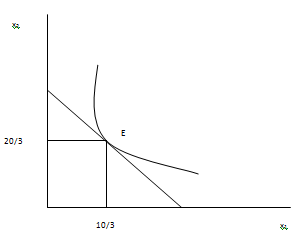
678_marginal rate of substitution.png

   Related Questions in Business Economics

  • Q : Gains from the Exchange Even people who

    Even people who are extremely good at everything couldn’t encompass: (i) absolute benefits in approximately everything. (ii) Much higher incomes than average. (iii) Comparative benefits in everything. (iv) Superior natural endowments of talent.

    Q : Adopting policy of paying efficiency

    The expected losses to workers by shirking are increased while a firm adopts a policy of: (1) dividing productive tasks therefore the division of labor is optimal. (2) paying efficiency wages that exceed market-clearing wages. (3) avoiding legal liability from not wri

  • Q : Price competition My friend can't

    My friend can't succeed to get the answer of this question. Give me solution of this question. From a heterodox perspective, why does destructive price competition drive enterprises to set up market institutions which would abolish price competition?

  • Q : Major implication of invisible hand of

    The major implication of Adam Smith’s conception of an “invisible hand” was such that: (w) pursuit of individual self interest must be controlled. (x) most people lose sight of what’s good for society. (y) most

  • Q : Elucidate state expenditures and

    Elucidate state expenditures and receipts for all states in 1998?

  • Q : Explain about the principle of

    Economic efficiency needs that, relative to the other goods which different individuals might consume, the people who value exact goods relatively the most should own and/or use all goods. Such principle is termed as: (i) economic equity. (ii) allocat

  • Q : Determine the Relative Price of given

    When turkey is $1 per pound and the relative price of ham to turkey is 2, in that case a pound of ham costs: (i) 50 cents. (ii) 1/2 pound of turkey. (iii) 2 pounds of turkey. (v) 12 pesetas. (iv) 5 euros. How can I

  • Q : Perfect Competition leads to Allocative

    A perfectly competitive industry achieves allocative efficiency since: w) goods and services are produced at the lowest possible cost. x) services and goods are produced up to the point where the last unit gives a marginal benefit to consumers equivalent to the margin

  • Q : Meaning of invisible hand according to

    Adam Smith’s opinion of an “invisible hand” powerfully implies the meaning that: (w) pursuit of individual self interest must be controlled. (x) most people lose sight of what’s good for society. (y) most peopl

  • Q : What are the 4 phases of the business

    What are the 4 phases of the business cycle?