--%>

Marginal costs for producing and selling

Monsieur Cournot has a monopoly on an artesian well from that flows tasty spring water along with medicinal properties. To ignore variable costs, he insists which customers bring their own pails as well as fill them individually. Cournot’s business policies give in marginal costs for producing and selling artesian spring water which equal: (1) €8 per liter. (2) €6 per liter. (3) €4 per liter. (4) €2 per liter. (5) zero.
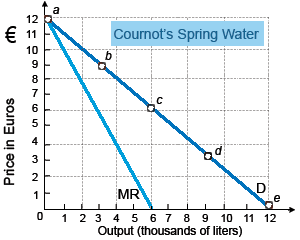
522_Elasticity and Total Revenue.png

Hello guys I want your advice. Please recommend some views for above Economics problems.

   Related Questions in Microeconomics

  • Q : Labor Contracts-Featherbedding The

    The Restrictive work rules which need firms to employ more workers than essential are termed as: (i) Feather-bedding. (ii) Seniority contracts. (iii) Blacklisting regulations. (iv) Agency shop provisions. (v) Yellow dog contracts.

  • Q : Third degree price discrimination Firm

    Firm A has no costs of production and sells its products to just two buyers. The buyers (1 and 2) have the following demand functions: P1 = 90 -10q1 P2 = 60 - 5q2 (a) Assuming that the rm can engage in third degree price discrimination, nd the

  • Q : Economic profits in long run A monopoly

    A monopoly will make economic profits within the short run: (w) but cannot create economic profits in the long run. (x) if average total costs [ATC] > P. (y) as long as total revenue exceeds total costs. (z) All of the above.

  • Q : Price equality to marginal costs A

    A nondiscriminating monopolist's equilibrium output is inconsistent along with: (w) marginal revenue equals marginal cost [MR = MC]. (x) price equal to marginal costs [P = MC]. (y) price exceeding average variable costs [P > AVC]. (z) price exceedi

  • Q : Analytic Time-Technological Long Run

    The chronological time needed for the technology to respond to modifications in profit opportunities (that is, the technological long run, also termed as super long run or temporal long run) is: (1) Longer than analytical long run for firm. (2) Shorter than market per

  • Q : Problem on Analysis Paralysis Consumers

    Consumers confronting huge arrays of choices whenever they contemplate choosing one brand of toothpaste out of 50, or whether to purchase pulp-free, not-from-concentrate orange juice, calcium-fortified, or the extra-pulp, non-calcified, from-concentrate version, frequ

  • Q : Unitarily price elastic while small

    When small raises or decreases within the price of generic bananas do not influence the total sales revenue from bananas, in that case the market demand for generic bananas is: (i) perfectly price elastic. (ii) perfec

  • Q : Price inelastic over relevant range of

    When the market demand for wheat is price inelastic over relevant range of prices, fluctuations within the supply of wheat will cause incomes of wheat farmers to: (w) increase when supply decreases and decline while the supply of whea

  • Q : Slopes of demand and supply curves The

    The slopes of demand and supply curves are frequently: (w) misleading as guides to price elasticities. (x) independent of the units measuring changes in price and quantity. (y) highly dependent upon each other. (z) used to forecast changing consumer t

  • Q : Relative profitability and efficiencies

    From around 1890 until 1970 year, the “structure-conduct-performance paradigm” dominated theories concerning how firms behave in various types of markets. Here the word “performance” in this context consider to things as: (i) d