--%>

Make out this new balance sheet

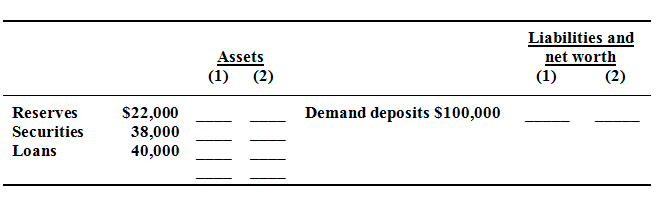
Balance sheet of Yukon Bank is given below. if reserve ratio is 10 percent. Estimate the maximum amount of new loans which bank can make? Demonstrates in column 1 how the bank's balance sheet will look after the bank has loaned this extra amount. Determine by how much has the supply of money altered? . How will the bank's balance sheet illustrates after cheques drawn for the overall amount of the new loans have been vacant against this bank? Make out this new balance sheet in column 2.
799_simplified balance sheet.png

E

Expert

Verified

Desired reserves are $10,000 (-10% of $100,000).

Excess reserves are $12,000 ($22,000 - $10,000), which this bank may safely lend.

While it does so, the money supply raise by $12,000.

Questions are answered below, along with the change in the desired reserve ratio factored in.              

760_new balance sheet.png

   Related Questions in Finance Basics

  • Q : Resolving ranking conflict Describe how

    Describe how to resolve a "ranking conflict" among the net present value and the internal rate of return. Why should the conflict be resolved as you described? Whenever there is a ranking conflict among net present value and internal rate of re

  • Q : Cyclical unemployment Suppose that in a

    Suppose that in a specific year the natural rate of unemployment is 5 percent and the actual rate of unemployment is 9 percent. Employ Okun's law to fin out the size of the GDP gap in percentage-point terms. If the nominal GDP is $500 billion in that year, how much ou

  • Q : Multiplier effect Normal 0 false false

    Normal 0 false false

  • Q : Explain Administratively Established

    Administratively Established Positions: The positions authorized by the Department of Finance throughout a fiscal year that were not comprised in the Budget and are essential for workload or administrative reasons. These positions fin

  • Q : How do flotation costs influence the

    Normal 0 false false

  • Q : Describe risk aversion Describe risk

    Describe risk aversion? Risk aversion is the tendency to ignore additional risk. Risk-averse people will ignore risk if they can, unless they attain additional compensation for letting that risk. In finance, the added compensation is a higher ex

  • Q : Define Grants Grants : It is generally

    Grants: It is generally used to explain amounts of money received by an organization for a particular purpose however with no obligation to repay (that is, in contrast to a loan, though the award might stipulate the repayment of funds under some situa

  • Q : Better risk measure in evaluating risk

    Why is the coefficient of variation a better risk measure to employ than the standard deviation while evaluating the risk of capital budgeting projects? The coefficient of variation is a better risk measure than the standard deviation alone sinc

  • Q : What can financial institution do for a

    What can a financial institution frequently do for a deficit economic unit (DEU) which it would have complexity doing for itself if the DEU were to deal directly with an SEU?SEUs typically desire to supply a small amount of funds, while DEUs typ

  • Q : What do you mean by the term Year of

    Year of Appropriation (YOA): It refers to the initial year of an appropriation.