--%>

Loss in social welfare with quantity, prices and costs

When pharmaceutical manufacturers conspire to generate only Q1 penicillin, in that case the: (i) purely-competitive firms which produced penicillin would experience economic losses. (ii) resulting excessive antibiotic treatments would produce strains of drug-resistant diseases. (iii) marginal social benefits of penicillin would exceed the marginal social costs. (iv) loss in social welfare would approximately equivalent the area of triangle bdg. (v) marginal social costs of penicillin would exceed the marginal social benefits.
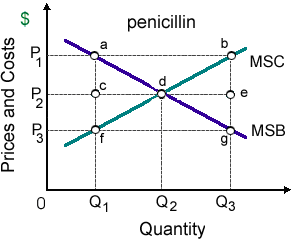
574_Efficiency and Welfare.png

I need a good answer on the topic of Economics problems. Please give me your suggestion for the same by using above options.

   Related Questions in Microeconomics

  • Q : Describe proportional in taxes as

    Line T1 depicts in given graph as in below a tax system which is: (i) progressive. (ii) recessive. (iii) proportional. (iv) biased. (v) regressive.

    Q : Measurement of arc price elasticity

    Measures of arc price elasticity tend to be more accurate and precise than measures of point price elasticity since: (w) arc elasticity is more sensitive to the dependent variable. (x) point elasticity is additionally sensitive to the independent vari

  • Q : Law of demand in Ceteris Paribus Can

    Can someone help me in finding out the right answer from the given options. The law of demand supposes that the income and tastes of the consumers are: (i) Strong determinants of the prices. (ii) Causes of movements all along the demand curve. (iii) C

  • Q : Different pure economics rent Pure

    Pure economic rents are different most from economic profits in which they are: (w) received by the owners of productive resources. (x) frequently costs to the firm using the resources which generate them, but not to society as a whol

  • Q : Problem on sole Proprietorships I have

    I have a problem in economics on Problem on sole Proprietorships. Please help me in the following question. The form of business association with the greatest potential financial liability for its owners is the: (1) Corporation. (2) Sole proprietorshi

  • Q : Relative profitability and efficiencies

    From around 1890 until 1970 year, the “structure-conduct-performance paradigm” dominated theories concerning how firms behave in various types of markets. Here the word “performance” in this context consider to things as: (i) d

  • Q : Operating analytic Time of

    When this purely-competitive firm makes output level Q, this is operating within the: (i) technological long run. (ii) long run. (iii) short run. (iv) shut down period. (v) boom period of the business cycle.

  • Q : Accepting prevailing market price by

    Unlike firms along with substantial market power, price takers: (w) control the prices of purchases or sales, but not their quality. (x) have no choice but to accept the prevailing market price. (y) adjust output and price to maximize profit. (z) are

  • Q : Words of Joseph A. Schumpeter about

    Joseph A. Schumpeter popularized and refined the concept that profits: (i) ultimately derive primarily from innovation. (ii) are necessary compensation to entrepreneurs for bearing uncertainty. (iii) are reduced by bureaucratic inefficiencies in firms

  • Q : Quantity Equilibrium I have the

    I have the quantity functions of demand and supply for two different goods, and I have to find the equilibrium of both the goods. Would I make all four functions equal to each other to find the equilibrium for the two goods? Or am I supposed to do something else?