--%>

Long-run supply curve in industry

When Christmas trees are a constant cost industry and such firm is typical, in that case the industry’s long-run supply curve is curve that is: (w) A. (x) B. (y) C. (z) E.
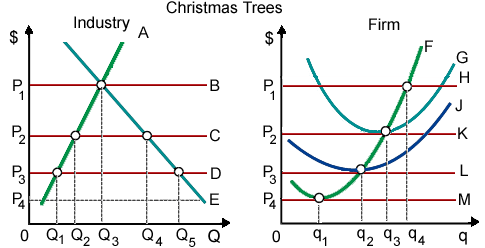
903_supply and demand1.png

I need a good answer on the topic of Economics problems. Please give me your suggestion for the same by using above options.

   Related Questions in Microeconomics

  • Q : Attribute Demand Curve for Bonds A

    A demand curve for bonds moving to the right is probably to be attributable to: (w) a business cycle recession. (x) lower expected (future) interest rates. (y) an increase into the expected rate of inflation. (z) an increase in the liquidity of altern

  • Q : Resource demands from purely

    Relative to the resource demands from purely competitive sellers, demands through imperfectly competitive firms for resources tend to: (1) Perfectly price elastic. (2) Upward sloping. (3) Backward bending. (4) Less price elastic. (5) Perfectly price inelastic.

  • Q : Total revenue minus total cost An

    An unregulated monopoly which does not price discriminate maximizes profit at the output level which maximizes: (w) P minus marginal costs [MC]. (x) total revenue minus total cost. (y) marginal revenue [MR] minus marginal costs [MC]. (z) price minus a

  • Q : Problem on excise taxes The incidence

    The incidence (burden) of excise taxes on chandeliers, airline tickets, jewelry, and yachts, is most probable to be: (i) Proportional. (ii) Hierarchical. (iii) Regressive. (iv) Unfair. (v) Progressive. Please someo

  • Q : Area below supply curve of resource The

    The area below a resource’s price line although above its supply curve is: (w) consumer surplus. (x) monopoly profit. (y) excess value. (z) economic rent. Can anybody suggest me the proper explanation for giv

  • Q : Pretax -posttax and transfer

    Refer to the following diagram. If line b represents the pretax and transfer distribution of income in the United States, we would expect the post-tax and transfer distribution to be: A) line a. B) line b, because taxes and transfers have no effect on income distribut

  • Q : Marginal social benefits of products If

    If an oligopoly achieves equilibrium, in that case the marginal social: (w) benefits of their products exceed the marginal social costs. (x) cost of their product exceeds the marginal social benefit. (y) benefits equal the marginal so

  • Q : Explanation of Substitution Effect The

    The substitution effect helps most in describing why: (1) Demand curves slope down. (2) Goods are either complements or substitutes. (3) Air travel costs less than by walking the cross country. (4) Uncertainty regarding quality justifies govt. control

  • Q : Economies of scale If there are

    If there are significant economies of scale in an industry, then: A) a firm that is large may be able to produce at a lower unit cost than can a small firm. B) a firm that is large will have to charge a higher price than will a small firm. C) entry to that industry wi

  • Q : Classification of firms Can someone

    Can someone please help me in finding out the precise answer from the following question. The summation of all the firms which produce a given product is categorized as: (1) Multinational. (2) An industry. (3) Cartel. (4) Monopoly. (5) Plant.