--%>

Long run equilibrium price

When Christmas tree farming is a decreasing cost industry and this firm is typical, in that case an increase in the market demand for Christmas trees will give in a long run equilibrium price: (1) greater than P1. (2) less than P2. (3) more than P3 but less than P2. (4) more than P4 but more than P3. (5) less than P4.
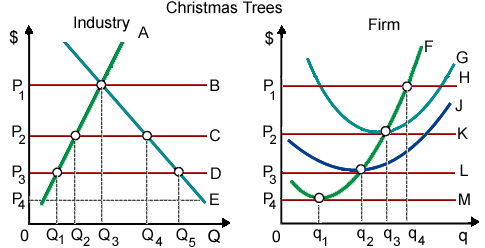
101_supply and demand1.png

Hello guys I want your advice. Please recommend some views for above Economics problems.

   Related Questions in Microeconomics

  • Q : Illegal price collusion Illegal price

    Illegal price collusion is probably when the market structure for an industry is: (1) monopolistic competition. (2) a monopoly. (3) an oligopoly. (4) pure competition. (5) contestable through exit and entry.

    Q : Problem on Supply Prices Can someone

    Can someone please help me in finding out the accurate answer from the following question. The relative monetary values organizations put on selling a bit more or less of a good are termed as: (i) Supply curves. (ii) Gain-maximizing prices. (3) Supply prices. (4) Pric

  • Q : Feature of pure competition NOT a

    NOT a feature of pure competition would be: (w) identical products of firms. (x) long-run freedom of entry and exit. (y) large numbers of sellers and buyers. (z) price making behavior by individual firms. I need a

  • Q : Competitive Markets-Unions of labor Can

    Can someone please help me in finding out the accurate answer from the following question? The purely competitive labor markets are not characterized through: (w) Most of the individual buyers and sellers of the labor services. (x) Wages equivalent to the marginal res

  • Q : Good taxed revenue of price inelastic

    Government tax revenue would raise most from a specified tax when the good taxed contain a relatively: (w) price elastic demand. (x) price inelastic demand. (y) unitary price elastic demand. (z) flatter demand curve.

    Q : Hicks Model of Collective Bargaining I

    I have a problem in economics on Hicks Model of Collective Bargaining. Please help me in the following question. The period of union strikes and the equilibrium wage rate at conclusion of a strike are the focus of: (i) Taft-Hartley Act of 1948. (ii) B

  • Q : Question related to Gross domestic

    Proprietors' income $ 20, Compensation of employees 300, Consumption of fixed capital 15, Gross investment 80, Rents 10, Interest 20 ,Exports 30, Imports 50, Corporate profits 25, Taxes on production and imports 5 ,Net foreign factor income 0 ,Statistical discrepancy

  • Q : Financial investments-traceable by most

    Most of the U.S. capital investment is traceable to the financial investments by households, that is one way that private individuals: (i) Turn into capitalists. (ii) Save. (iii) Evade taxes. (iv) Avoid the circular flow of resources and income.

    Q : Charting of past prices Can the

    Can the charting of past prices be used to predict future prices?

  • Q : Comparative advantage in making food

    When Wilma can make a brontosaurus burger in 10 min and a cactus cooler in 5, whereas Betty can make the burger in 8 min and the cactus cooler in 3. Then find out the right option from the above: (1) Betty consists of a comparative disadvantage in the coolers and a co