--%>

Long run entry of supply curve

When the price for cranberries is primarily P1, in that case in the long run: (w) firms will neither enter nor exit this industry. (x) entry of firms will move curve supply curve A to the right. (y) exit of firms will move supply curve A to the left. (z) entry of new firms will shift this firm’s curve F to the right.
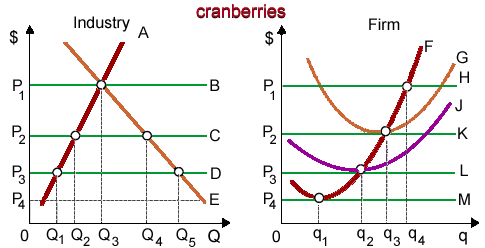
1461_demand and supply.png

How can I solve my Economics problem? Please suggest me the correct answer.

   Related Questions in Microeconomics

  • Q : Law of Distribution by Pareto “ Law of

    “Law of Distribution” given by Vilfredo Pareto asserts that the: (w) relative prices for goods reflect how intensively labor is used as an input. (x) the percentages of national income going to labor and to capital is a co

  • Q : Indication of Lorenz Curves The Lorenz

    The Lorenz curve gives an indication of: (w) the poverty rate. (x) dead end poverty. (y) relative poverty. (z) post-transfer poverty. Hello guys I want your advice. Please recommend some views for above Eco

  • Q : Profit Maximization in Labor Markets

    Each and every profit maximizing organizations employ labor up to the point where: (1) VMP = w. (2) MRP = MFC. (3) VMP = MRP. (4) VMP = MFC. (5) MR MC is maximized. Can someone please help me in finding out the accurate answer from

  • Q : Substitution Effect-decreasing

    The substitution effect is negative since people react to a price raise by: (i) Reducing purchases of good. (ii) Generating more of good. (iii) Purchasing some substitute goods. (iv) Working less to sustain the existing purchasing patterns.

    Q : Agricultural demand The demand for

    The demand for agricultural products is: A) relatively elastic with respect to price. B) relatively inelastic with respect to price. C) relatively elastic with respect to income. D) downward sloping to the individual farmer, but perfectly elastic to farmers as a group.

  • Q : Effective price discrimination to

    Effective price discrimination to maximize profit does NOT needs the firm to be capable to: (w) separate the market within different groups along with different demand elasticities. (x) erect entry barriers to defend a monopoly position. (y) prevent t

  • Q : Levels of output by monopolistic

    Monopolistic competitors generate levels of output which are: (w) more than socially optimal and equitable. (x) economically efficient. (y) where marginal social benefits exceed marginal social costs. (z) certain to generate economic profits.

  • Q : Purely-competitive long-run equilibrium

    The typical firm produces in a purely-competitive long-run equilibrium where price equals as: (1) short-run average cost. (2) marginal cost. (3) long-run average cost. (4) average revenue per unit. (5) All of the above.

    Q : Total variable cost while maximizes

    Total cost when such firm maximizes economic profits would be: (w) $72,000 per period. (x) $80,000 per period. (y) $96,000 per period. (z) $100,000 per period.

    Q : Quantity Equilibrium I have the

    I have the quantity functions of demand and supply for two different goods, and I have to find the equilibrium of both the goods. Would I make all four functions equal to each other to find the equilibrium for the two goods? Or am I supposed to do something else?