--%>

Least consistent demand curve with existence of substitution

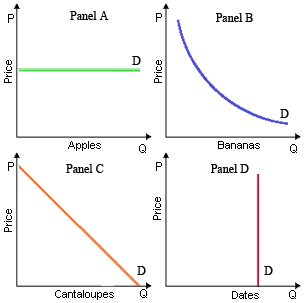
The demand curve which is least consistent along with the existence of a substitution consequence is within: (w) Panel A. (x) Panel B. (y) Panel C. (z) Panel D.
1809_Slope and Elasticity1.png

I need a good answer on the topic of Economics problems. Please give me your suggestion for the same by using above options.

   Related Questions in Microeconomics

  • Q : Determinant of consumer spending Give

    Give me the answer of this question. The most important determinant of consumer spending is: A) the level of household debt. B) consumer expectations. C) the stock of wealth. D) the level of income.

  • Q : Absolute and relative price is the

    is the price in the law of demand an absolute price or a relative price

  • Q : Economies of scale exist in range of

    Natural monopoly refers to a market or industry in that: (w) economies of scale exist across much of the complete range of market demand. (x) superior management enables a firm to remove its competitors. (y) a firm produces a good protected through pa

  • Q : Price elasticity of supply computations

    At a $2 price per can, there quantity of applesauce supplied per day is 1000 cases; and at $4, the quantity supplied is 3000 cases per day. Therefore price elasticity of supply is: (i) 2/3. (ii) 1/3.(iii) 3/2. (iv) 1/4.

    Q : Demand when total revenue uninfluenced

    When total revenue to a firm is uninfluenced by small price changes, in that case demand is: (1) relatively price elastic. (2) relatively price inelastic. (3) unitarily price elastic. (4) vertical. (5) horizontal.

  • Q : Define demand with market supply and

    When technological advances boost market supply and total revenue both within an industry, in that case: (w) demand is relatively price elastic. (x) the industry is dominated by a monopoly. (y) patenting technological advances ensures

  • Q : Constant-cost in short-run

    In a constant-cost, there purely-competitive industry in the short-run: (w) and long-run supply curves are positively sloped. (x) and long-run supply curves are negatively sloped. (y) and long-run supply curves are horizontal. (z) sup

  • Q : Problem on Jurisdictional Strikes The

    The Taft-Hartley Act prohibited strikes against the firm over the issue of which of two or more competing unions would symbolize the firm’s employees. These strikes are termed as: (i) Jurisdictional strikes. (ii) Strategic representation strikes

  • Q : Purely competitive firms in long-run

    Purely competitive firms in long-run equilibrium as: (w) should use the most efficient technology available. (x) follow cut throat policies to produce more than society demands. (y) produce output levels where TC = TR = MR = MC = P = AR = AC. (z) have

  • Q : Purely competitive decreasing cost

    When a decreasing cost industry is purely competitive in that case: (1) each firm’s long-run supply curve is downward sloping. (2) each firm encounters increasing returns to scale. (3) growth of industry output yields lower per unit costs. (4) c