--%>

Least consistency for law of demand

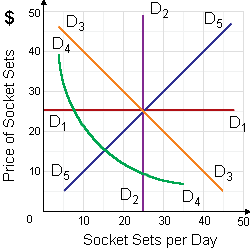
The demand curve for socket sets from the list below which is least consistent along with the law of demand is: (w) demand curve D1D1. (x) demand curve D2D2.  (y) demand curve D3D3. (z) demand curve D4D4.
888_Price Elasticity of Demand.png

How can I solve my economics problem? Please suggest me the correct answer.

   Related Questions in Microeconomics

  • Q : What is the meaning of ex-ante savings

    Meaning of ex-ante savings: Ex-ante savings are expected savings or planned savings.

  • Q : Changes in supply and demand curves

    This alters in the supply- and demand-curves for textbooks could not have resulted from a change in: (w) taxes. (x) relative prices for text books. (y) expectations about future prices. (z) prices for related goods.

  • Q : Where is the price elasticity of supply

    The price elasticity of supply as in below demonstrated figure is unitary within: (w) Panel A. (x) Panel B. (y) Panel C. (z) Panel D.

    Q : Increase profits of quantity selling by

    When a monopolist was selling a quantity which marginal revenue [MR] is greater than marginal costs [marginal costs [MC] in that case this could increase profits by: (w) raising price. (x) increasing output. (y) raisi

  • Q : Potential inefficiencies and inequities

    Whenever someone paying for the service can’t completely monitor the behavior or aims of the person offering the service, there are potential inequities and inefficiencies caused by the: (1) Moral hazard. (2) Adverse selection. (3) Utilitarianism. (4) Principal-

  • Q : Perfectly price inelastic and price

    A vertical demand curve (when one existed) would be ____________ _____________ during its entire range when a horizontal demand curve is ____________ ____________: (w) relatively price inelastic; perfectly price inelastic (x) perfectly price elastic; perfectly price i

  • Q : Traditional transfer in kind assistance

    Most traditional transfer in kind helps programs: (w) increased benefits for every dollar earned. (x) reduced benefits by $1 for every dollar earned. (y) reduced benefits by less than $1 for each dollar earned. (z) reduced benefits by more than $1 for

  • Q : When is Price Ceiling not create

    Price ceilings do NOT create pressures for: (w) shortages of price controlled goods. (x) black markets, queuing, or sales by favoritism. (y) opportunity costs to be lower than or else. (z) transactions at monetary prices below the equilibrium price.

  • Q : Monopolistically-competitive market

    When numerous new firms enter a monopolistically-competitive market, in that case the demand curves facing the firms previously in that market will: (1) shift to the left and turn into more price elastic. (2) become straighter and less income elastic.

  • Q : Vigorously competitive market

    Economic rents which can be capitalized are least possible to arise by: (1) production cost advantages. (2) proprietary knowledge. (3) being first to market a differentiable new product or to innovate a new production technology. (4) a vigorously comp