--%>

Law of rising opportunity costs

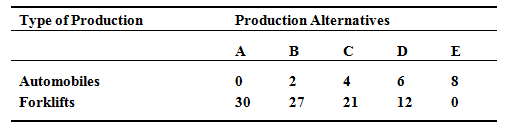
Below described table is a production possibilities table for consumer goods (automobiles) and capital goods (forklifts):
1918_Production possibilities curve.png

If the economy is at point C, describe the cost of one more automobile? Of one more forklift? Describe how the production possibilities curve reflects the law of rising opportunity costs.

E

Expert

Verified

4.5 forklifts; .33 automobiles, as find out from the table.  Rising opportunity costs are reflected in the concave-from-the-origin shape of the curve.  This means the economy has to give up larger and larger amounts of rockets to obtain constant added amounts of automobiles—and vice versa.

   Related Questions in Finance Basics

  • Q : Inflationary expenditure gap or

    Normal 0 false false

  • Q : Describe Reappropriation

    Reappropriation: The expansion of an appropriation’s accessibility for encumbrance and/or expenses beyond its set annihilation date and/or for a new point. Re-appropriations are usually authorized by statute for 1-year at a time however might be

  • Q : What is Prior Year Adjustment Prior

    Prior Year Adjustment: An adjustment for the difference among prior year accruals and real expenditures or revenues. The previous year adjustment amount is usually comprised in the Fund Condition Statements as an adjustment to realign the starting fun

  • Q : Define Bill Bill : It is a draft of

    Bill: It is a draft of proposed law represented to the Legislature for performance. (A bill has bigger legal formality and standing than a resolution.) OR An invoice, or document statement, of an amount owing for s

  • Q : Define Organization Code Organization

    Organization Code: The four-digit code allotted to each state governmental entity (and at times to exclusive budgetary programs) for fiscal system aims. The organization code is the initial segment of the budget item or appropriation

  • Q : Describe primary reasons that companies

    Describe primary reasons that companies hold cash? Companies hold cash to make essential payments, to take benefit of opportunities as they arise, and to cover unforeseen emergencies.

  • Q : Purchasing power parity of US and

    Under what condition would the U.S. dollar and the Canadian dollar said to be have achieved purchasing power parity? The U.S. dollar and the Canadian dollar would be assumed to have achieved purchasing power parity while the exchange rate reflec

  • Q : Are there security and soundness

    Are there security & soundness implications of mergers?No. All mergers needs regulatory approval and are subject to intense examination through regulators. If anything, the influence on safety and soundness is in general positive, as mergers

  • Q : Describe matching principle of working

    Describe matching principle of working capital financing? Explain the benefits of following this principle? The matching principle is while short-term financing is utilized for temporary current assets while long-term financing is utilized for

  • Q : Describe trustworthy collateral from

    Describe trustworthy collateral from the lenders' perspective? Describe whether accounts receivable and inventory are trustworthy collateral. Assets which are readily marketable, of stable value, and not likely to "disappear" make for trustwort