--%>

Labor and Revenue in Purely Competitive Firm

Short run total revenue of the purely competitive firm would be at a maximum along with: (1) 600 workers. (2) 700 workers. (3) 800 workers. (4) 900 workers (5) 1000 workers.
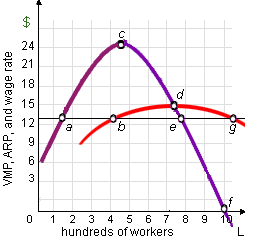
444_Problem on Demand for Labor.png

Can someone explain/help me with best solution about problem of Economics...

   Related Questions in Managerial Economics

  • Q : Adjust inputs of labor other resources

    Firms adjust their inputs of labor or other resources till: (w) revenue is maximized. (x) employment is maximized. (y) marginal product of labor is maximized. (z) profit is maximized. Please choose the right answer

  • Q : Attempt Screening and Signaling

    Screening and signaling are attempts to: (w) decreases job interview time. (x) decrease the problem of adverse selection. (y) uphold equal opportunity laws. (z) All of the above. I need a good answer on the topic o

  • Q : Requirements for Food production I have

    I have a problem in economics on Diminishing Returns. Please help me in the following question. In a completely employed food-and-clothing economy, equivalent successive raises in food production will ultimately need successively: (i) Larger increases

  • Q : Accumulation of certificates of

    A potential employee’s accumulation of certificates and degrees to stimulate interest through a potential employer is termed by economists as: (1) specific training. (2) signaling. (3) general training. (4) screening. (5) ticket-punching. <

  • Q : Find demand when Supply and Demand

    Suppose that the auto started began at the intersection of S0 and D0, and then Congress passed a main personal income tax cut. So, how will it affect the auto market?: (w) No change. (x) Demand shifts to D2. (y) Demand shifts to D

  • Q : Supply of Labor to Competitive Firms

    For a firm hiring through a purely competitive labor market, in that case the supply of labor is: (w) greater than the MRC. (x) less than the MRC. (y) the same as the MRC. (z) vertical to parallel the wage rate.

    Q : Pay the lowest wages in market

    Occupations along with the highest percentage of women workers tend to: (1) pay the highest wages. (2) need relatively more human capital and experience. (3) pay the lowest wages. (4) require very small human capital or experience.

  • Q : Labor Productivity Where diminishing

    Where diminishing returns overwhelm gains through the division of specialized labor, when there is an inflection point on the total revenue curve derived by a total output curve, and by the vantage point of a purely competitive firm h

  • Q : Average wages for workers Average

    Average female wages are historically beneath the average for male workers due to: (w) concentration in low income occupations. (x) placement in low status job positions. (y) lower admission in professional schools and skilled trades.

  • Q : Maximizes profit by hiring labor A firm

    A firm maximizes profit through hiring labor at the point where labor’s: (1) marginal physical product equals its average physical product. (2) marginal revenue product equals its marginal resource cost. (3) rate of exploitation is greatest. (4)