--%>

Inflationary expenditure gap or recessionary expenditure gap

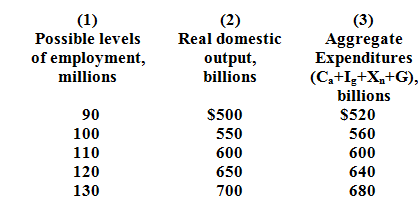
Refer to the table below in answering the questions which follow:
1617_inflationary expenditure gap or recessionary expenditure gap.png

In this economy if full employment is 130 million, will there be an inflationary expenditure gap or recessionary expenditure gap? Describe the consequence of this gap? By how much would aggregate expenditures in column 3 ought to change at each level of GDP to remove the inflationary expenditure gap or recessionary expenditure gap? Illustrates. Describe multiplier in this example?

E

Expert

Verified

A recessionary gap. Equilibrium GDP is $600 billion, whereas full employment GDP is $700 billion. Employment = 20 million less than at full employment. Aggregate expenditures would have to rise by $20 billion (= $700 billion -$680 billion) at each level of GDP to abolish the recessionary gap. The MPC is .8, thus the multiplier is 5.

   Related Questions in Finance Basics

  • Q : Making capital structure decisions In a

    In a perfect capital market, what advice would you give a corporate financial manager on making capital structure decisions? Justify your advice. How and why would your advice change as real world capital market imperfections are introduced?

    Q : Define Planning Estimate Line Planning

    Planning Estimate Line: The separate planning estimate adjustment or entry for a specific expenditure or type.

  • Q : Difference in annuities due or ordinary

    Normal 0 false false

  • Q : Define Appropriations Limit

    Appropriations Limit, State (SAL): The constitutional limit on the expansion of some appropriations from tax proceeds usually set to the level of the previous year's appropriation limit as adjusted for modifications in cost of living

  • Q : Explain Plan of Financial Adjustment

    Plan of Financial Adjustment (PFA): This is the plan proposed by a department, accepted by the Department of Finance, and acknowledged by the State Controller's Office (SCO), to allow the SCO to assign costs paid from one item to one

  • Q : Describe risk aversion Describe risk

    Describe risk aversion? Risk aversion is the tendency to ignore additional risk. Risk-averse people will ignore risk if they can, unless they attain additional compensation for letting that risk. In finance, the added compensation is a higher ex

  • Q : Calculate the slope of the curve Normal

    Normal 0 false false

  • Q : Explain Workload Budget Workload Budget

    Workload Budget: Workload Budget means the budget year cost of presently authorized services, adjusted for modifications in caseload, enrollment, population, statutory cost-of-living adjustments, one-time expenditures, chaptered legislation, full-year

  • Q : The official unemployment rate Normal 0

    Normal 0 false false

  • Q : Assignments i want to write final

    i want to write final report about my state Texas. using the resources that i attached and the other resources to cover the outlines.