--%>

Incurs total costs by profit maximization

This profit-maximizing brickyard as in illustrated figure incurs total costs of approximately: (i) $1200 daily. (ii) $1300 daily. (iii) $1400 daily. (iv) $1530 daily (v) $1600 daily.
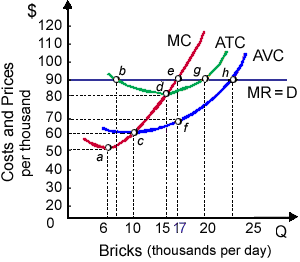
2450_Profit Maximization1.png

Can someone explain/help me with best solution about problem of Economics...

   Related Questions in Microeconomics

  • Q : Unambiguously Poverty Poverty is most

    Poverty is most unambiguously: (w) an absolute concept that is easily and precisely defined. (x) more prevalent in North America than elsewhere. (y) the absence of income sufficient to survive in reasonable comfort. (z) a relative concept when poverty

  • Q : Fundamental welfare benefits by

    The incentive to work and earn income is possible to be greatest when the fundamental welfare benefit is ____ and the fundamental welfare benefit is reduced through ____ that the person earns: (w) high, the amount (x) low, the amount

  • Q : Demand for loanable funds An increase

    An increase in the demand for loanable funds is reflected within an increase in the: (1) term structure of interest rates. (2) demand for money. (3) supply of bonds. (4) supply of money. (5) demand for bonds. I nee

  • Q : Supply in the short run and long run

    Supply is too elastic (contain a smaller coefficient) within the long run than in the: (w) short-run in competitive, constant-cost industries. (x) short-run in competitive, increasing-cost industries. (y) market period in virtually all industries. (z) All of the above

  • Q : Market-period supply curve For a purely

    For a purely competitive industry a market-period supply curve would be: (i) curve A. (ii) curve B. (iii) curve C. (iv) curve D. (v) curve E.

    Q : Workers in monopsonistic labor markets

    I have a problem in economics on Workers in monopsonistic labor markets. Please help me in the following question. The workers in monopsonistic labor markets receive salaries: (i) That barely cover the subsistence. (ii) Beneath the value of marginal p

  • Q : Complementary of cross-price elasticity

    The most complementary of the given pairs of goods are: (1) organic vegetables and French fries. (2) polyester fabrics and cotton cloth. (3) transistor radios and televisions. (4) jogging shoes and bicycles. (5) pencils and erasers.

    Q : Labor Contracts-Check-off Provisions

    I have a problem in economics on Labor Contracts-Check-off Provisions problem. Please help me in the given question. The statement of check-off provision: (1) Was outlawed through Taft Hartley Act. (2) Is unlawful in union shops. (3) Simplifies the un

  • Q : Monopolistic competition firm in

    firm in monopolistic competition maximizes its profit by producing where its price is equal to its marginal cost." Is this statement correct or incorrect? Explain.

  • Q : Stickiness of prices in oligopolistic

    The "kinked-demand-curve" model was developed into the 1930 year in part to help describe: (i) barriers to entry in oligopoly markets. (ii) the allegedly excessive stickiness of prices into oligopolistic industries. (iii) how competitive industries be