--%>

Increasing cost industry in long run supply curve

When curve C reflects the long run supply curve as in demonstrated figure for this industry, in that case this is a/an: (w) decreasing cost industry. (x) increasing cost industry. (y) constant cost industry. (z) diseconomies of scale industry.
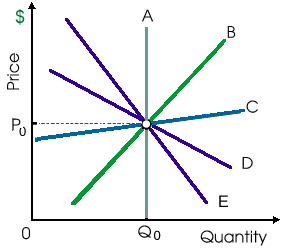
2350_purely competitive industry.png

Hello guys I want your advice. Please recommend some views for above Economics problems.

   Related Questions in Microeconomics

  • Q : Collapse of Cartels A purpose NOT often

    A purpose NOT often cited for the collapse of cartels would be: (w) price cheating. (x) inability to deter entry. (y) government prosecution. (z) merger into monopoly. Hey friends please give your opinion for the p

  • Q : Purely competitive market and constant

    When this firm is typical in illustrated figure of this purely competitive market and when this is a constant-cost industry, in that case the long run supply curve for the industry is a horizontal line which would go from: (1) point c

  • Q : Advertising for higher prices Brand

    Brand name aspirin sells on higher prices than generic aspirin since: (w) higher prices mean higher quality. (x) they are chemically superior. (y) they cost more to produce. (z) advertising campaigns relate the brand name along with quality.

  • Q : Differentiate project feasibility study

    Differentiate between project feasibility study and project proposal?

  • Q : Labor markets profit maximization When,

    When, after hiring the very last worker, the organization’s profit is similar as it was before the last worker was hired, then the firm must: (1) Hire more workers to raise the profit. (2) Layoff some workers to raise the profit. (3) Not appoint any more workers

  • Q : Important of economies of scale to

    Karl Marx's prediction which competition ultimately leads to monopoly is most likely to be valid while: (w) diseconomies of scale discourage competition. (x) there are always constant returns to scale. (y) economies of scale are important relative to

  • Q : Measure Liquidity An asset’s associate

    An asset’s associate “liquidity” is inversely measured through the: (w) transaction costs in dealing within the asset as a proportion of the market price of the asset. (x) time it takes to convert this to cash. (y) “backing&rdq

  • Q : Problem on Supply Prices Can someone

    Can someone please help me in finding out the accurate answer from the following question. The relative monetary values organizations put on selling a bit more or less of a good are termed as: (i) Supply curves. (ii) Gain-maximizing prices. (3) Supply prices. (4) Pric

  • Q : Natural barriers to entry technology

    Natural barriers to entry would include: (w) long established brand loyalty. (x) enforcement of existing antitrust laws. (y) technology which dictates large plant size. (z) patents and copyright laws. Can anybody s

  • Q : Bond Prices and Interest Rates When you

    When you buy a bond at an interest rate of 15 percent and sell it while the interest rate is 10 percent, then you will: (w) receive more than you paid for the bond. (x) receive less than you paid for the bond. (y) receive similar amount that you paid