--%>

Increase in Income Tax Progressivity

When this figure demonstrated Lorenz curves for distribution of income after taxes and transfers, in that case it is UNTRUE of the Lorenz curves demonstrated in this demonstrated figure that: (1) line 0E0' represents a Lorenz curve of perfect equality. (2) line 0A0' represents a Lorenz curve where only one family receives income. (3) line 0D0' shows a more equal distribution of income than line 0C0'. (4) an increase in income tax progressivity would be likely to move the Lorenz curve from line 0D0' to line 0C0'.
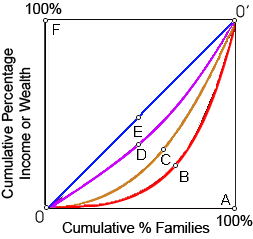
1718_Problem on Lorenz Curve.png

Hello guys I want your advice. Please recommend some views for above Economics problems.

   Related Questions in Microeconomics

  • Q : Demand curves relatively more elastic

    Scrutiny of demand curves DD and D0D0 reveals such that: (1) D0D0 is relatively more elastic at a price of P1. (2) DD is relatively more elastic at a price of P2. (3) D0D0 probably reflects the demand f

  • Q : Determine the market price when demand

    When both demand and supply rise within the market for cell phones, we would suppose the market price to: (w) increase. (x) decrease. (y) increase, decrease, or stay similar, depending upon the relative magnitudes of the shifts. (z) s

  • Q : Pre-tax and pre transfer income

    From 1950, the pre-tax and pre transfer income distribution comprises: (w) become more equitably distributed. (x) remained about constant. (y) become less equitably distributed. (z) moderated because the rich and the poor both lost income to the middl

  • Q : Monopsony how do you determine

    how do you determine equilibrium for nurses in a monopsony

  • Q : Economic profit generating purely

    In this illustrated figure in below the only purely competitive firm currently generating economic profit is in: (w) Firm A. (x) Firm B. (y) Firm C. (z) Firm D.

    Q : Increase total revenue and exceeds

    When a firm along with market power raises the price of a good a little, total revenue as: (w) falls in the inelastic range of the demand curve. (x) rises over the elastic range of the demand curve. (y) stays close to zero in the unit

  • Q : Maximum economic profits in purely

    For this purely competitive firm, area P2P1de shows: (1) fixed cost (TFC). (2) losses, but the minimum possible economic loss. (3) average fixed cost (AFC). (4) maximum economic profits. (5) the rate of return on investment.

  • Q : Price equality with marginal costs It

    It is not possible for a nondiscriminating, that profit maximizing monopolist to attain equilibrium where MR = MC as well as: (w) economic profit = 0. (x) economic profit is negative. (yz marginal costs are at the minimum of average costs [MC = ATC].

  • Q : Occurrence of natural barriers to entry

    Natural barriers to entry within a market arise primarily by: (w) strategies by existing firms to discourage the entry of new firms. (x) perfectly inelastic demands for products. (y) the declining cost structure inherent in producing specific goods. (

  • Q : Implication of freedom of entry and

    Describe the implication of freedom of entry and exit to the firms beneath perfect competition.