--%>

Inconsistent of demand with standard consumer theory

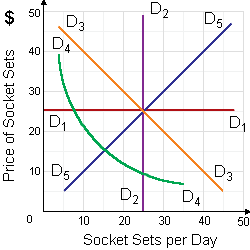
The curve which is so inconsistent along with standard consumer theory which is based only on the substitution result, this could not possibly be a demand curve for any standard kind of consumer good is: (1) curve D1D1. (2) curve D2D2.  (3) curve D3D3. (4) curve D4D4. (5) curve D5D5.
1948_Price Elasticity of Demand.png

Please choose the right answer from above...I want your suggestion for the same.

   Related Questions in Microeconomics

  • Q : Stabilization function Choose the right

    Choose the right answer of thefollowing problem. In performing its stabilization function, it may be appropriate for the nation's central bank (the Federal Reserve in the United States) to take actions to: A) increase taxes to reduce inflation. B) increase interest ra

  • Q : Output From the heterodox approach,

    From the heterodox approach, what options does the enterprise need to produce more output? What effect do these options put on its cost structure?

  • Q : Implicit Costs-Value of time

    Congratulations! You have made a fortune after establishing the firm which publishes bestselling books of the economic poetry. Your implicit costs comprise: (1) Salaries for your firm’s website designer. (2) The value of your time. (3) Fees for cleaning the serv

  • Q : Elasticity and profit maximization A

    A nondiscriminating monopolist cannot maximize profits through producing where demand: (w) price elastic. (x) price inelastic. (y) above marginal cost. (z) above marginal revenue. Can someone explain/help me with b

  • Q : Market economies of individual

    In the market economies, resources are finally owned by the: (i) Corporations which dominate the economic activity. (ii) Proprietorships and partnerships. (iii) Business firms collectively. (iv) Individual house-holds. (v) Government acting as the social trustee.

  • Q : Equilibrium price in short run The

    The equilibrium prices for cranberries within the short run of: (w) P1. (x) P2. (y) P3. (z) P4.

    Q : Produce a natural monopoly by market

    Market forces tend to produce a natural monopoly while: (1) decreasing costs are small relative to market demand for output. (2) diseconomies of scale are substantial at low levels of output. (3) economies of scale are substantial relative to market d

  • Q : Unitary price elasticity of demand curve

    HoloIMAGine has patented a holographic technology which makes 3-D photography obtainable to consumers. So the demand curve facing HoloIMAGine has unitary price elasticity at: (i) output q1. (ii) output q3. (iii) output q4

  • Q : Perfect competition ‘In the real world

    ‘In the real world there is no industry which conforms precisely to the economist’s model of perfect competition. This means that the model is of little practical value

  • Q : Relatively price elastic when supply

    Even though a drought decreases supply from S1 to S0, at each point along both of such supply curves, the supply of tanks of dehydrated water: (i) perfectly price elastic. (ii) relatively price elastic. (iii) unitarily price elastic. (iv) relativ