--%>

Income rate variation in Loren curve

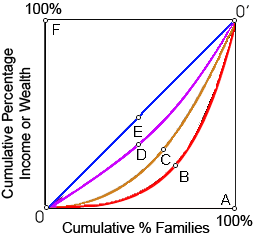
When you were unconcerned about the welfare of other people and your income rated you onto the top two percent of the population, then you would be happiest while the Lorenz curve for your country resembled as: (1) line 0A0'. (2) line 0B0'. (3) line 0C0'. (4) line 0D0'. (5) line 0F0'.
1133_Problem on Lorenz Curve1.png

Can anybody suggest me the proper explanation for given problem regarding Economics generally?

   Related Questions in Microeconomics

  • Q : Elasticity and profit maximization An

    An imperfectly competitive firm can maximize profit within the long run only at prices and also outputs where demand elasticity is: (w) greater than or equal to 1. (x) less than 1. (y) less than 0. (z) between 0 and 1.

    Q : Question related to Monopoly Refer to

    Refer to the following figure . Assume the graphs represent the demand for use of a local golf course for which there is no significant competition (it has a local monopoly); P indicates the price of a round of golf; Q is the quantity of rounds "sold" each day. If th

  • Q : Price floor for Whopper Slushees The

    The government price floor for Whopper Slushees at P3 would result a: (i) shortage of Q1 – Q3. (ii) Excess of Q3 - Q1. (iii) Supply price of P1. (iv) Quantity demanded of Q2. (v) Demand price of P2.

    Q : Elasticity and profit maximization A

    A nondiscriminating monopolist cannot maximize profits through producing where demand: (w) price elastic. (x) price inelastic. (y) above marginal cost. (z) above marginal revenue. Can someone explain/help me with b

  • Q : Profit Maximization-total revenue-total

    The entire profit maximizing organization will hire more labor up to the point where: (i) Average physical product of labor equivalents the nominal wage. (ii) Last unit of labor adds uniformly to net revenue and net cost. (iii) Marginal product of the labor is at its

  • Q : Illegal price collusion Illegal price

    Illegal price collusion is probably when the market structure for an industry is: (1) monopolistic competition. (2) a monopoly. (3) an oligopoly. (4) pure competition. (5) contestable through exit and entry.

    Q : Wage rate in equilibrium for monopsony

    Marginal revenue product of the labor surpasses the: (i) Additional revenue generated by each extra unit of labor. (ii) Value of marginal product of labor merely for the competitive sellers of output. (iii) Average fixed cost for natural monopoly. (iv

  • Q : Monopoly and competition theory The

    The theorist who set the stage for much of the “new” theory of international trade through blending theories of monopoly and competition to suit the case of several sellers offering differentiated products was: (1) Leon Walras. (2) Vilfred

  • Q : Opponents of Contribution Standard

    Opponents of contribution standard for income distribution, the: (w) prefer a more efficient mechanism to distribute income. (x) accept marginal productivity theory. (y) question how well the market system measures productivity. (z) generally favor de

  • Q : Natural monopolies closely regulated by

    Inside the United States, public utilities like natural gas lines or electric companies are frequently: (w) quite competitive while they vie for the consumer's dollars. (x) natural monopolies which are closely regulated by government. (y) seldom closely regulated thro