--%>

Income in Lorenz curve of welfare

When you were unconcerned regarding the welfare of other people and your income placed you into the bottom five percent of the population, in that case you would be happiest when the Lorenz curve for your country resembled as: (1) line 0A0'. (2) line 0B0'. (3) line 0C0'. (4) line 0D0'. (5) line 0F0'.
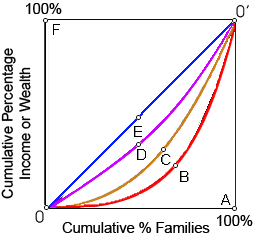
1637_Problem on Lorenz Curve1.png

I need a good answer on the topic of Economics problems. Please give me your suggestion for the same by using above options.

   Related Questions in Microeconomics

  • Q : Net income under the negative income tax

    Under the negative income tax system demonstrated in this given figure, a family of four along with earned income of $75,000 per year would have a net as [after-tax] income of: (i) $15,000 per year. (ii) $30,000 per y

  • Q : Price ceilings causes shortages of a

    When price ceilings cause shortages of a good in that case the good tends to be: (1) replaced by substitutes by many consumers. (2) allocated by several non price mechanism. (3) more valuable to consumers than the money prices charged

  • Q : Majority of surviving below the poverty

    In the United States, a mainstream of those living below “the poverty line”: (1) have televisions, automobiles, main appliances, and other amenities possessed only by the wealthy [when anyone] in earlier times and nowadays, only by the wea

  • Q : Elasticity of supply Suppose that the

    Suppose that the price of peanut packets increases by 5 %, the quantity supplied of peanut increases by 8 %. Then what is the elasticity of supply? Answer: Es = Per

  • Q : Total variable cost when maximizes

    Total variable cost when this firm maximizes economic profits would be: (i) $12,000 per period. (ii) $24,000 per period. (iii) $32,000 per period. (iv) $48,000 per period. (v) $60,000 per period.

  • Q : Excess supply at the minimum price

    Programs which guarantee farmers minimum prices which exceed equilibrium prices will yield: (w) cheaper food for consumers. (x) excess demand in food markets. (y) excess supply at the minimum price. (z) higher equilibrium prices.

  • Q : Greatest percentage rate of return The

    The greatest percentage rate of return would be generated through a financial investment which yielded: (w) annual income = $1,000; current price = $10,000. (x) monthly income = $100; current price = $24,000. (y) annual income = $1,200; current price = $10,800. (z) an

  • Q : Opportunity costs in different prices

    While a firm is NOT able of price discrimination: (w) various prices are charged for units of remotely related goods. (x) only opportunity costs are reflected in various prices for units of similar good. (y) any short term profit stimulates long run l

  • Q : Changes in Bonds and Interest Rates

    When you buy a bond if the interest rate is 10% and sell this while the interest rate is 15%, in that case you will receive: (w) less than you paid for the bond. (x) more than you paid for the bond. (y) the same amount which you paid for the bond. (z)

  • Q : Diseconomies of scale problem Can

    Can someone help me in finding out the right answer from the given options. When the average production costs rise as the total production of a firm rises, the firm is experiencing: (1) economies of scale. (2) Economies of scope. (3) Diseconomies of scope. (4) Disecon