--%>

Income elasticity of positive and increasing demand

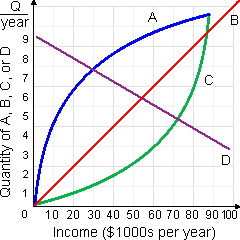
This given figure as in below demonstrates how consumption of goods A, B, C and D varies like a family’s income changes. Since income rises, the income elasticity of demand is positive and increasing for: (w) good A. (x) good B  (y) good C. (z) good D.
945_Income Elasticity of Demand.png

Can anybody suggest me the proper explanation for given problem regarding Economics generally?

   Related Questions in Microeconomics

  • Q : When is price elasticity of demand

    The price elasticity of demand is considered as to be inelastic when the computed value is: (w) less than one although greater than zero. (x) greater than zero. (y) one. (z) zero. Hello guys I want your advice. Ple

  • Q : Elasticity of supply Suppose that the

    Suppose that the price of peanut packets increases by 5 %, the quantity supplied of peanut increases by 8 %. Then what is the elasticity of supply? Answer: Es = Per

  • Q : Measurement of cross-elasticity of

    The cross-elasticity of demand measures as: (1) the changes in quantities sold when the price of related good changes. (2) changes within the prices of substitute goods. (3) changes within the prices of complementary goods. (4) how quantities sold cha

  • Q : Blacklisting-Labor history Can someone

    Can someone please help me in finding out the accurate answer from the following question. Firms which colluded by circulating the names of the union organizers and hence they would have difficulty getting jobs were engaged in a now-illegal practice termed as: (1) Fea

  • Q : Exit from a competitive industry Exit

    Exit from a competitive industry will carry on till economic: (w) losses are driven to zero. (x) profits precisely offset accounting losses. (y) profit exceeds accounting profit. (z) resources have minimum incomes.

  • Q : Economy-efficiency while transaction

    Transaction costs tend to be decreased, consumer prices tend to be lower and additionally stable and economy-wide efficiency is enhanced if: (1) rigid wage and price controls are imposed. (2) central planning fosters

  • Q : Principal-Agent Problems-Institutions

    According to the John Kenneth Galbraith, the modern corporate planning: (i) Aims at decreasing risks to the managers of main firms. (ii) Stresses the maximization of gains. (iii) Is much concerned with the social goals. (iv) Maximizes the social welfare.

  • Q : Spread of wage information The

    The Employers frequently discourage the spread of wage information since they fear that: (i) Lower salaried workers might use the information to negotiate the raises. (ii) Firms honor employee’s privacy only when secrecy is reciprocated. (iii) Unions try to orga

  • Q : Maximizing utility from consumption of

    Given that a MU of French fries of 35 utils and a MU for the serving of potato chips at 25 utils, when their respective prices are $1.50 and $.80, a person who wishes to maximize the utility from the consumption of both of such goods would consume: (1) The similar amo

  • Q : Barriers to entry and long run

    A firm which realizes an economic profit in the short run will carry on generating economic profits in the long run only when: (i) it maximizes economic revenue. (ii) barriers to entry prevent entry from rival firms. (iii) its managers minimize princi