--%>

Income effect of a small wage rate changes

The income effect of a small change within the wage rate for that worker most strongly exceeds the substitution effect at a wage rate of: (1) $5 per hour. (2) $10 per hour. (3) $10 per hour to $25 per hour. (4) $25 per hour to $40 per hour. (5) $40.01 per hour and up.
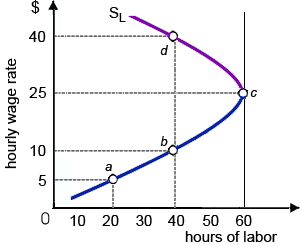
910_Problem on Supply of Labor.png

How can I solve my Economics problem? Please suggest me the correct answer.

   Related Questions in Managerial Economics

  • Q : Explain the term business cycle in brief

    Explain the term business cycle in brief.

  • Q : Labor-Leisure Trade-offs The relative

    The relative price of leisure rises while there are increases within the: (w) supply of labor. (x) wage rate. (y) cost of living. (z) marginal tax rate on income. Can someone explain/help me with best solution abou

  • Q : Wage Rates and Marginal Resource Costs

    When a firm is a price taker into the labor market and the wage is $80 daily, the marginal resource cost incurred while hiring 20 more workers daily is: (w) $80. (x) $1600. (y) $800. (z) $400.

    Q : Human Capital and the Demand for Labor

    Investment in human capital is not essentially involved while: (w) people acquire and sharpen new productive skills. (x) a person attends college and learns engineering. (y) a person jogs to stay in shape. (z) the marginal productivity of labor increa

  • Q : PRICE ELASTICITY OF DEMAND THE PRICE OF

    THE PRICE OF OIL IS $30 PER BARREL AND THE PRICE ELASTICITY IS CONSTANT AND EQUAL TO -0.5.AN OIL EMBARBGO REDUCES THE QUANTITY AVAILABLE BY 20 PERCENT.USE THE ARC ELASTICITY FORMULA TO CALCULATE THE PERCENTAGE INCREASE IN THE PRICE OF OIL

  • Q : What are the reasons for adopting

    What are the reasons for adopting penetration price strategy?

  • Q : Initially purely competitive labor

    When this purely competitive labor market is firstly into equilibrium at D0L, S0L, raise in labor productivity will result within equilibrium being attained at: (w) D0L, S0L. (x) D1L, S0L

  • Q : Derived Demand in Competitive Labor

    Derived demand refers to: (w) consumer demand for products, based on expected utility. (x) government demand for social goods, based upon tax revenue. (y) business demand for resources, based upon consumer demand for products. (z) supplier demand for

  • Q : Employment Screening If job applicants

    If job applicants are asked for letters of recommendation and copies of their college transcripts, in that case a firm is practicing: (1) wage discrimination. (2) employment screening. (3) job signaling. (4) a structural employment system (5) credentialism.

  • Q : Describe why firms may shut down

    If a perfectly competitive firm determines that its market price is below its minimum average variable cost, this will sell: w) the output where marginal revenue equivalents marginal cost. x) any positive output the entrepreneur decid