--%>

Income effect of a small change in wage rate

The income effect of a small change within wage rate is approximately identical to the substitution consequence for Glynn at: (i) point a. (ii) point b. (ii) point c. (iv) point d. (v) point e.
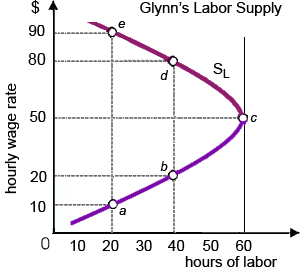
1272_Labor-Leisure Trade-offs.png

How can I solve my Economics problem? Please suggest me the correct answer.

   Related Questions in Microeconomics

  • Q : Determine profit maximizing A

    A monopolist has an inverse demand curve given by p(y) = 12 - y and a cost curve given by c(y) = y2. (a) What will be its profi t maximizing level of output?

  • Q : Production in a competitive market

    Production within a competitive market system tends to be: (1) a process that exploits labor to the maximum. (2) geared to respond to the whims of central planners. (3) relatively efficient and low cost. (4) highly automated because labor costs more t

  • Q : Define investment demand function

    Investment demand function: Investment demand function is the relationship among rate of interest and investment demand. There is an inverse relationship among the rate of interest and investment demand. High inter

  • Q : On which point demand appears to be

    On this demonstrated figure of demand curve for DVD games, demand appears to be approximately unitarily elastic at: (w) Q = O, P = $50. (x) Q = 10, P = $O. (y) Q = 5, P = $25. (z) No point on the demand curve.

    Q : Problem on demand curve Give me answer

    Give me answer of this question. Refer to the following diagram. Other things equal, a rightward shift of the demand curve would: A) depreciate the dollar.  B) appreciate the dollar. C) reduce the equilibrium quantity of euros. D) depreciate the euro.

  • Q : Profit Maximization problem Can someone

    Can someone help me in finding out the right answer from the given options. The Firms adjust their inputs of the labor or other resources till: (1) Revenue is maximized. (2) Employment is maximized. (3) Marginal product of the labor is maximized. (4) Gain is maximized

  • Q : Marginal cost by price discriminate

    When a monopolist which does not price discriminate maximizes profit and charges a price equal to marginal cost, this will: (i) minimize average cost and generate zero economic profit. (ii) minimize average cost and generate a positiv

  • Q : Problem regarding Rational Ignorance

    Whenever decision makers select not to pursue further information as the expected reward for the searching for it does not surpass its expected cost, the outcome is: (1) Adverse choice. (2) Consumer exploitation. (3) Unintended effects. (4) Asymmetric information. (5)

  • Q : Relatively price inelastic demand in

    When a firm possesses some market power, in that case the firm’s marginal revenue is negative inside the range of output where demand is: (i) price elastic. (ii) unitarily elastic. (iii) relatively price inelastic. (iv) perfectl

  • Q : Monopsonistic-Wage Discrimination

    Whenever an organization’s wage structure reflects the keenness of individual staff to work, terms which are most applicable comprise: (p) Monopsonistic exploitation & wage discrimination. (q) Monopolistic exploitation and the separation of possession and co