--%>

Income effect at a wage rate

The substitution effect of a small change within the wage rate for this worker most strongly goes beyond the income effect at a wage rate of: (1) $5 per hour. (2) $10 per hour. (3) $10 per hour to $25 per hour. (4) $25 per hour to $40 per hour. (5) $40.01 per hour and up.
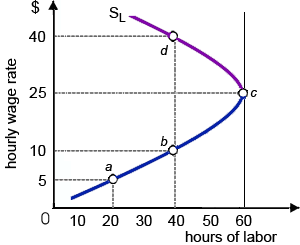
520_Problem on Supply of Labor.png

Can someone explain/help me with best solution about problem of Economics...

   Related Questions in Managerial Economics

  • Q : Explain the Arc Method of Measurement

    Explain the Arc Method of Measurement of Elasticity.

  • Q : Define the term business forecasting

    Define the term business forecasting briefly.

  • Q : Forecasting demand what are the

    what are the criteria for good forecasting

  • Q : Process of Screening A principal who

    A principal who checks the qualifications of a potential agent before giving the agent a contract is engaging within the process of: (i) signaling. (ii) determining an efficiency wage. (iii) predatory behavior. (iv) screening. (v) discrimination.

    Q : Differentiate between Private Cost and

    Differentiate between Private Cost and Social Cost.

  • Q : Best Potential Efficiency Wages

    Attempts to decrease shirking by paying workers more than they could earn within their next best potential jobs involves: (1) screening. (2) corporate acculturation. (3) efficiency wages. (4) signaling. (5) collective bargaining. H

  • Q : Investment in Human Capital An

    An investment in human capital is most obviously illustrated while: (1) Biff Biceps lifts weights before going to the beach to surf. (2) Cary Coffee drinks four cups of latte before going to work. (3) Pollyanna reads Harlequin Romance novels within he

  • Q : Maximizes profit by hiring labor A firm

    A firm maximizes profit through hiring labor at the point where labor’s: (1) marginal physical product equals its average physical product. (2) marginal revenue product equals its marginal resource cost. (3) rate of exploitation is greatest. (4)

  • Q : Concept of derived demand The concept

    The concept of derived demand means that: (w) consumer demands for goods depend on the utilities received from their use. (x) firms’ demands for resources depend upon consumer demands for the goods produced. (y) governmental demands for social g

  • Q : Purely competitive labor market in

    When this purely competitive labor market is firstly in equilibrium at D0L , S0L , an increase into labor force participation rates will result within equilibrium being attained at: (w) D0L , S0L . (x) D