--%>

Income effect and substitution effect

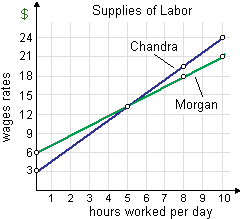
When comparing these labor supplies, which are clear by the income effect of a modification in wage rates is: (w) negative for Morgan and positive for Chandra. (x) less powerful than substitution effect for both of such workers. (y) positive for Morgan and negative for Chandra. (z) larger, relative to the substitution effect, for Morgan than this is for Chandra.
347_Labor Leisure Tradeoffs.png

Can anybody suggest me the proper explanation for given problem regarding Economics generally?

   Related Questions in Managerial Economics

  • Q : Elasticity of Demand for Labor in Firm

    Increasing the wage rate increases total wages received through workers when the demand for labor is: (w) relatively elastic. (x) relatively inelastic. (y) unitarily elastic. (z) perfectly elastic.

  • Q : What are the types of price

    What are the types of price discrimination?

  • Q : Price Taker in Labor Supply Curves

    When a firm is a price taker in the labor market, in that case the: (w) wage is constant for any quantity of labor this would hire. (x) marginal resource cost of labor is constant for any quantity of labor this would hire. (y) wage equals the marginal

  • Q : Demand for labor in purely competitive

    When the hourly wage rate for workers this purely competitive firm hires is approximately of $13, this will operate at: (1) point a. (2) point b. (3) point c. (4) point d. (5) point e.

    Q : What are the scopes of managerial

    What are the scopes of managerial economics?

  • Q : Aggregate Supply of Labor Labor

    Labor supplies for the economy as an entire are LEAST determined through: (w) labor unions. (x) wage rates and structures of wages. (y) education and training of the work force. (z) labor force participation rates. Hey friends plea

  • Q : Charging the competitive price in the

    An apparent monopoly might charge the competitive price in the long run when: (w) exit is costly. (x) entry and exit are relatively costless. (y) this is not a natural monopoly. (z) this is not regulated.

    Q : Move downward demand for labor The

    The demand for labor would move downward like a consequence of: (w) grocery stores buying fewer automatic check-out touchpad computers, and in place of relying more heavily on cashiers to ensure friendly interactions along with customers. (x) declines

  • Q : Statements about Human Capital Which of

    Which of the given statements is not CORRECT: (w) Acquiring productive skills is known as investment in human capital. (x) General training increases a worker’s marginal productivity equally for many firms. (y) Specific training increases the productivity of the

  • Q : General Training in Human Capital The

    The knowledge regarding local shrubs and trees which Morgan learns whereas working as an apprentice landscaper into the suburbs of a huge city is an illustration of the benefits from: (1) dirty work. (2) general training. (3) dues-paying. (4) high-skilled employment.