--%>

Income distribution after taxes and transfers

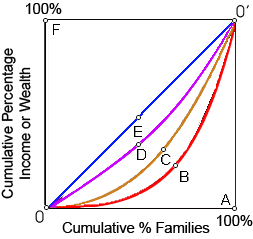
When line 0C0' shows income distribution before taxes and transfers, in that case the line that shows income distribution after taxes and transfers would be: (1) line 0A0'. (2) line 0B0'. (3) line 0C0'. (4) line 0D0'. (5) line 0E0'.
1810_Problem on Lorenz Curve1.png

Hey friends please give your opinion for the problem of Economics that is given above.

   Related Questions in Microeconomics

  • Q : Profit maximization of an output level

    Profit is maximized when this brickyard manufactures an output level of: (1) 6,000 generic bricks daily. (2) 7,000 generic bricks daily. (3) 15,000 generic bricks daily. (4) 17,000 generic bricks daily. (5) 20,000 generic bricks daily.

    Q : Proprietorships-Limited liability Which

    Which of the given below is not a benefit of the sole proprietorship? (i) Limited liability. (ii) Easiness of organization. (iii) Flexibility. (iv) Freedom from govt. regulation. Choose the right answer from the above options.

  • Q : Graphical relationship depicted by

    Demand curves graphically depict the relationships which are: (i) Positive among the demand for a good and its relative price. (ii) Negative between the quantity demanded and the opportunity cost of a good. (iii) Positive between income and expenditures. (iv) A horizo

  • Q : Types of market economies What are the

    What are the types of market economies?

  • Q : Equal Income Distribution The income

    The income distribution tends to become more equal most quickly as countries become more: (1) socialistic. (2) capitalistic. (3) economically developed. (4) centrally planned. (5) agricultural. Please choose the ri

  • Q : Maximizes total revenue by a monopolist

    A monopolist maximizes total revenue through producing where is: (w) marginal revenue = marginal cost [MR = MC]. (x) marginal revenue = 0. (y) demand is elastic. (z) demand is inelastic. How can I solve my

  • Q : Supply in the short run and long run

    Supply is too elastic (contain a smaller coefficient) within the long run than in the: (w) short-run in competitive, constant-cost industries. (x) short-run in competitive, increasing-cost industries. (y) market period in virtually all industries. (z) All of the above

  • Q : Statement of Law of Demand The law of

    The law of demand defines that when a good’s price increases, its quantity demanded will drop: (1) No matter what occurs to other variables. (2) When all as well is supposed constant. (3) Since its demand curve shrinks. (4) If substitutes become

  • Q : Increasing in real market rate of

    The real market rate of interest will increase when there is an increase into: (w) pessimism on the parts of investors. (x) willingness to hold illiquid assets. (y) total capital stock relative to national output. (z) households’ desires to cons

  • Q : Arising of perfect price discrimination

    Perfect price discrimination would arise when a firm: (1) extracted full consumer surpluses from its customers. (2) permitted monopolistic customers quantity discounts. (3) redistributed real income among consumers. (4) inefficiently allocated its res