--%>

Imports good in purely competitive labor market

When this purely competitive labor market is primarily in equilibrium at of D0L, S0L, a shift to equilibrium at D2L, S0L would be probably to follow by increases in: (1) minimum wage laws. (2) imports of this good from foreign competitors. (3) workers' desires for leisure as well as willingness to sacrifice extra income. (4) general training of these workers. (5) the depreciation rate for capital used through these firms because of obsolescence.
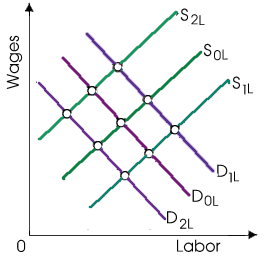
2394_Labor Market Equilibria.png

Can someone explain/help me with best solution about problem of Economics...

   Related Questions in Managerial Economics

  • Q : General Training in Human Capital The

    The knowledge regarding local shrubs and trees which Morgan learns whereas working as an apprentice landscaper into the suburbs of a huge city is an illustration of the benefits from: (1) dirty work. (2) general training. (3) dues-paying. (4) high-skilled employment.

  • Q : Explain opinion of Stonier and Hague

    Illustrates the opinion of Stonier and Hague for explaining Demand in economics?

  • Q : Define the term cost plus pricing

    Define the term cost plus pricing.

  • Q : Wage rate at demand of labor When the

    When the wage rate price of $13, in that case this firm would hire slightly fewer than: (i) 600 workers. (ii) 700 workers. (iii) 800 workers. (iv) 900 workers (v) 1000 workers.

    Q : What did professor Hidbon illustrates

    What did professor Hidbon illustrates about Demand?

  • Q : Explain the business decision based

    Explain the business decision based upon income elasticity.

  • Q : Introduction of the term Marginal

    Provide a brief introduction of the term Marginal Costing? And also write down the essential suppositions made by Marginal Costing?

  • Q : Elasticity of the Supply of Labor of

    This supply of labor worker is roughly unitarily wage elastic as the wage rate increases from: (1) $5 per hour to $10 per hour. (2) $5 per hour to $25 per hour. (3) $10 per hour to $25 per hour. (4) $10 per hour to $40 per hour. (5) $25.01 per hour to

  • Q : Wage rate and price of leisure

    Increases within the wage rate all the time: (w) lack impact on the relative price of leisure. (x) increase the relative price of leisure. (y) decrease the relative price of leisure. (z) increase the quantity of individual labor supplies.

  • Q : Competitive Market Supplies of Labor

    The supply curve of labor which confronts a large but purely competitive industry is usually: (1) horizontal. (2) positively sloped. (3) backward bending. (4) vertical. (5) negatively sloped. Can a