--%>

Import cars in equilibrium

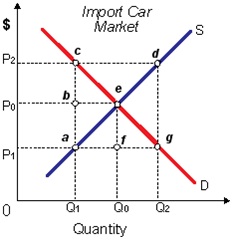
When the import car market is in equilibrium prior to the government limits car imports to Q1, the price that buyers will reimburse for an import: (1) Drops/falls from P0 to P1. (2) Is stable, although dealer gains fall by Q0 to Q1. (3) Increases from P0 to P2. (4) Exhibits a subsidy wedge of P2 to P1.
1752_4.jpg

Can someone help me in getting through this problem.

   Related Questions in Microeconomics

  • Q : Bond of fixed annual income A bond

    A bond which pays a fixed annual income always is: (w) an eternity. (x) a perpetuity. (y) worthless. (z) infinitely valuable. Can anybody suggest me the proper explanation for given problem regarding Econom

  • Q : Present Value of Capitalization The

    The present value of $1000 two years by now is: (w) $1000. (x) greater than $1000. (y) less than the present value of $1000 one year by currently. (z) $1,210. Hey friends please give your opinion for the problem of Economics that i

  • Q : Price Rigidity Price Rigidity: The

    Price Rigidity: The other significant feature of oligopoly is price rigidity. Price is rigid or sticky at the prevailing level due to the fear of reaction from the rival firms. When an oligo

  • Q : Least commonly finance investment in

    Business firms least commonly finance investment within new economic capital by: (w) retained earnings. (x) the issuance of common or preferred stocks. (y) borrowing from banks or other financial institutions. (z) gra

  • Q : Current consumption over future

    When households’ start increasingly to prefer current consumption over future consumption, in that case the: (w) interest rate rises. (x) interest rate falls. (y) present value of future income rises. (z) equilibrium rate of investment within hu

  • Q : Cartel Select the right answer of the

    Select the right answer of the question. We would expect a cartel to achieve: A) both allocative efficiency and productive efficiency. B) allocative efficiency, but not productive efficiency. C) productive efficiency, but not allocative efficiency. D) neither allocati

  • Q : Horizontal summation of individual

    The purely competitive industry’s demand for the labor is: (i) Less elastic than the horizontal summation of individual firm’s demands. (ii) Perfectly elastic. (iii) Upward sloping as of the diminishing marginal returns to labor. (iv) Equi

  • Q : Wealth distribution by income When line

    When line 0C0' shows the 2005 U.S. income distribution, in that case the line that would shows the 2005 wealth distribution would be probably line: (1) line 0A0'. (2) line 0B0'. (3) line 0C0'. (4) line 0D0'. (5) line 0E0'.

  • Q : Vigorously competitive market

    Economic rents which can be capitalized are least possible to arise by: (1) production cost advantages. (2) proprietary knowledge. (3) being first to market a differentiable new product or to innovate a new production technology. (4) a vigorously comp

  • Q : Purely competitive firms in long-run

    Purely competitive firms in long-run equilibrium as: (w) should use the most efficient technology available. (x) follow cut throat policies to produce more than society demands. (y) produce output levels where TC = TR = MR = MC = P = AR = AC. (z) have