--%>

Import car market in equilibrium before restricts it

While the import car market is in equilibrium before the government restricts car imports to Q1, the price which buyers will pay for an import as: (1) falls from P0 to P1. (2) is stable, although dealer profits fall by Q0 to Q1. (3) rises from P0 to P2. (4) shows a subsidy wedge of P2 to P1.
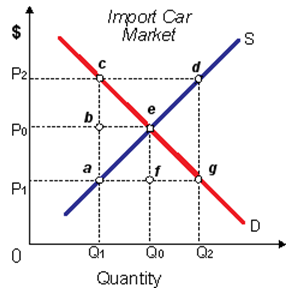
1750_Trade Barriers.png

Hello guys I want your advice. Please recommend some views for above economics problems.

   Related Questions in Microeconomics

  • Q : Average of incurring total fixed costs

    This brickyard is incurring total fixed costs which average about: (1) $200 daily. (2) $300 daily. (3) $400 daily. (4) $500 daily (5) $600 daily.

    Q : Exploitation of Labor-average revenue

    The Exploitation might not exist even when the wage a worker is paid is less than worker’s: (1) Average revenue product. (2) Marginal revenue product. (3) Marginal factor cost. (4) The value of marginal product. Can someone p

  • Q : Typical pure competitor firm in industry

    When this firm is a typical pure competitor within this industry as in demonstrated figure, then the firm is: (i) making normal accounting profit. (ii) making zero economic profit. (iii) breaking even. (iv) into an industry within long run equilibrium

  • Q : Annual total costs When Nostalgia

    When Nostalgia Corporation maximizes profit in its production of Silver Screen DVDs, in that case its annual total costs will be around: (i) $45 million. (ii) $65 million. (iii) $85 million. (iv) $105 million. (v) $125 million. <

  • Q : Determine average total cost curve

    LoCalLoCarbo has become the favorite of fad dieters. There in given figure curve D shows: (1) LoCalLoCarbo’s marginal cost curve. (2) LoCalLoCarbo’s average variable cost curve. (3) LoCalLoCarbo’s average total cost curve. (4) the market demand curve

  • Q : Help economics !! The market system's

    The market system's answer to the fundamental question "Who will get the goods and services?" is essentially: 1) "Those willing and able to pay for them." 2) "Those who physically produced them." 3) "Those who most need them." 4) "Those who get utility from them."

  • Q : Consumer Surplus-Difference in amounts

    Kiley pays $1.00 for the cold Pepsi on a hot afternoon, however would be willing to pay $5.00. The $4.00 difference in such amounts is her: (i) Consumer surplus. (ii) Income effect. (iii) Economic gain. (iv) Marginal utility. (v) Pleasure coefficient.

    Q : Potential advantage offer by Oligopolies

    Oligopolies offer a potential advantage to society since them: (w) may be capable to amass the huge resources required for modern research and growth. (x) tend to be more socially responsible than small firms. (y) typically maximize long run quite tha

  • Q : Profits of monopoly firm A monopoly

    A monopoly firm's profits: (w) equal only normal profits in long-run equilibrium. (x) may be whatever level the firm wishes. (y) are maximized where MC = MR. (z) tend to be lower than that of pure competitors. Hell

  • Q : Subjective preferences of Marginal

    I have a problem in economics on Subjective preferences of Marginal Utility. Please help me in the following question. The Marginal utilities: (1) Reflect the subjective preferences. (2) Are realistically evaluated by wealth. (iii) Are set by the demo