--%>

Illustration regarding to market adjustments

When the soybean market begins within equilibrium upon S0D0 and in that case a highly publicized study demonstrates yoghurt to be much more nutritious than the tofu made by soybeans, the market changes to: (w) S0D2. (x) S1D2. (y) S0D1. (z) S2D0.
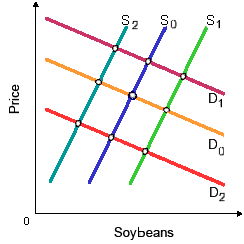
267_soybean market in equilibrium.png

Hello guys I want your advice. Please recommend some views for above economics problems.

   Related Questions in Public Economics

  • Q : Global warming Can someone please

    Can someone please explain me that global warming, litter and pollution are all examples of...(v) produced goods, (w) by-products, (x) technological spin-offs, (y) errors in judgment and (z) economic bads. How can I solve my economics problems? Please

  • Q : Market adjustments change equilibrium

    A movement along the demand curve for a good would be caused through changes within: (1) preferences and tastes. (2) costs for productive resources. (3) supply which change the equilibrium price of the good. (4) expectations regarding future prices.

  • Q : Administrative estimations of peoples

    The requirement criterion of distribution usually entails: (1) Greater production incentives than the other systems. (2) Much difficult administrative estimations of people's requirements. (3) Generation of extreme pollution. (4) Dividing national inc

  • Q : Problem of macroeconomics in economics

    Can anybody advise me the proper explanation for given problem regarding macroeconomics in Economics generally. In macroeconomics, where we examine all things like the: (w) problems of What, How, and For Whom. (x)

  • Q : Problem on public sector The word “

    The word “public sector” signifies to: (1) Stockholders and households. (2) Investors and Consumers. (3) Households and investors. (4) Democratic voting systems. (5) All actions of government. Find out the right answer from the above optio

  • Q : Define the normative economics in

    Hello guys I want your opinion. Please suggest your answer for following Normative-economics problem. Normative economics: (i) based upon value judgments. (ii) involves statements which are either right or wrong. (

  • Q : Explain about the term whom in

    The fundamental economic questions are "What?”, “How?”, and “For whom”? When we ask, "For whom?", we need to know who will: (w) produce the goods. (x) consume the goods. (y) get the profits. (z) decide wh

  • Q : Problem regarding the distributive

    Ted and Willy are eating lunch. Ted has a Snowball and Willy a Ding Dong for dessert. Strongly prefer both Ding Dongs. A required trade of Willy's Ding-Dong for Ted's Snowball would be likely to enhance: (w) distributive efficiency as Fred is better off. (x) allocativ

  • Q : Problem on economic system of a country

    The economic system of a country is generally categorized according to: (1) Who makes decisions and who owns that resources. (2) Whether it is totalitarian or democratic. (3) Its per capita GDP and its currency value in the Euros or U.S. dollars. (4)

  • Q : Better off and worse off condition in

    When an economic change makes ten percent of the population better off and has no consequence on the economic welfare of the other ninety percent, in that case: (w) the community is better off. (x) the community is worse off. (y) community economic welfare does not ch