--%>

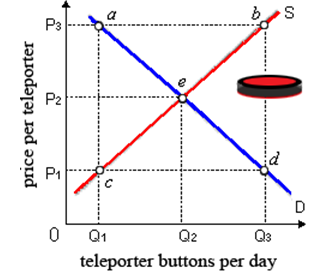
Illustration of teleporter market in equilibrium

The teleporter market would show a surplus when: (1) teleporter buttons were priced at P3. (2) Q2 teleporter buttons were produced and sold at a price of P2. (3) teleporter buttons were priced at P2. (4) Q3 teleporter buttons were produced and sold at a price of P3. (5) teleporter buttons were priced at P1.
378_Equilibrium for Buyers.png

How can I solve my economics problem? Please suggest me the correct answer.

   Related Questions in Microeconomics

  • Q : Utility Analysis problem The marginal

    The marginal utility curve can much loosely be translated into the demand curve by: (1) Measuring its declining part in dollars. (2) Transforming utils into the prices. (3) Horizontally summing up everyone’s MUs at each and every price. (4) Setting MUa/Pa = MUb/

  • Q : Decreasing price of Complementary Goods

    The increase in demand for tartar sauce would be a probable result of: (1) A reduction in the price of fish. (2) An raise in the price of tartar sauce. (3) A bumper crop of the tartar sauce. (4) A raise in the price of fish. (v) The reduction in price

  • Q : Supply curve of a purely competitive

    A purely competitive firm has a supply curve which is: (w) perfectly elastic. (x) relatively inelastic. (y) flatter than its demand curve. (z) upward sloping as output increases. Hello guys I want

  • Q : Prices and costs in monopoly market

    When this monopoly generates Q units: (1) P > MC. (2) MR = MC. (3) total revenue total cost is maximized. (4) MSB > MSC. (5) All of the above.

    Q : Demand in a specific period In adding

    In adding up to price, the quantity of a good bought throughout a given period is recognized by: (1) Income. (2) Tastes and preferences. (3) Numbers of buyers in market. (4) Prices of associated goods. (e) All of above. Can someone

  • Q : Short-run supply curve of a competitive

    At any point on short-run supply curve of a competitive industry, every firm produces at the similar: (w) rate of technological equilibrium. (x) average cost. (y) marginal cost. (z) positive level of economic profit.

    Q : Purchasing low selling high Purchasing

    Purchasing low in one market and concurrently selling at a high price in another is NOT a mechanism which: (i) Rises supply in the low-price market. (ii) Risklessly produces profits. (iii) Is termed as arbitrage. (iv) Decreases price differentials among markets. (e) I

  • Q : Price floor for Whopper Slushees The

    The government price floor for Whopper Slushees at P3 would result a: (i) shortage of Q1 – Q3. (ii) Excess of Q3 - Q1. (iii) Supply price of P1. (iv) Quantity demanded of Q2. (v) Demand price of P2.

    Q : When would transaction cost be zero All

    All transaction costs would be zero when: (1) Congress required current prices to be cut by eighteen percent. (2) market information and transportation were both costless. (3) market prices were legally restricted to production costs. (4) inflation we

  • Q : A legal price floor and revenues Assume

    Assume that the U.S. wheat market is firstly into equilibrium on S0D0. Now assume the government institutes a legal price floor at P3 per bushel of wheat. When the government does nothing else, one outcome will be such