--%>

Hike within the minimum legal wage effects

Labor market advises that a hike within the minimum legal wage from $5 per hour to $8 per hour will decrease: (1) the crime rate by 3,000. (2) national unemployment rates. (3) employment among unskilled workers by approximately 1,500 positions. (4) the federal budget deficit.
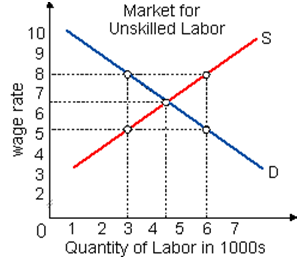
944_Minimum Wage Laws.png

Hello guys I want your advice. Please recommend some views for above economics problems.

   Related Questions in Microeconomics

  • Q : Bond of fixed annual income A bond

    A bond which pays a fixed annual income always is: (w) an eternity. (x) a perpetuity. (y) worthless. (z) infinitely valuable. Can anybody suggest me the proper explanation for given problem regarding Econom

  • Q : Economic idea of pure competition The

    The market circumstances most intimately conforming to the economic idea of pure competition would be as: (w) a broccoli farmer and the national market for broccoli. (x) your local cable company and the consumer market for cable TV. (y) Nissan vs. GM

  • Q : Median Relative Income Measurement A

    A family which has income greater than half the median incomes of other American families, although less than twice which median income, is categorized by the Department of the Census as: (1) impoverished. (2) low relative income. (3) working class. (

  • Q : Define normal goods Normal goods:

    Normal goods: Normal goods are such goods whose demand increases with the increase in income of consumer.

  • Q : Amount of output supplied and price

    The amount of output supplied is exactly proportional to the price therefore the price elasticity of supply equivalents one into: (w) Panel A. (x) Panel B. (y) Panel C. (z) Panel D.

    Q : Profits and Losses-Natural selection

    The Natural selection theory states that the manager’s failures to maximize the profits cause: (i) Firing of its managers. (ii) The firm’s collapse. (iii) Outside take-overs. (iv) All of the above. Can someone please he

  • Q : Problem on individual supply curves The

    The market supply curve is derived via: (i) Evaluating the net costs for each potential level of output. (ii) Inverting (or taking the mirror image of) the market demand curve. (iii) Horizontally summing up individual supply curves. (iv) Averaging the

  • Q : Output produces by monopolistic

    This monopolistic competitor generates Q0 output where is: (1) MR = MC. (2) MSB > MSC. (3) average cost is not minimized. (4) P = ATC. (5) All of the above.

    Q : Economic good becomes an economic bad

    Economic good becomes an economic bad whenever consumption is expanded into an area where: (1) Marginal returns are reducing. (2) Sellers experience an honest hazard. (3) Marginal utility is negative. (4) Buyers suffer from unfavorable choice. (5) Exc

  • Q : Contribution Standard The concept that

    The concept that people must have income in proportion to their productivity is termed as the: (1) equality standard of distribution. (2) productivity standard of distribution. (3) needs standard of distribution. (4) utility standard