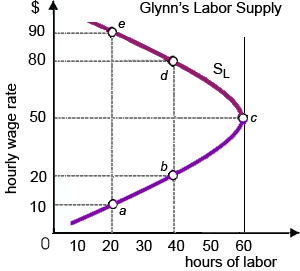
Highest income in supply
Glynn s weekly income would be the highest at: (1) point a. (2) point b. (3) point c. (3) point d. (4) point e. I need a good answer on the topic of Economics problems. Please give me your suggestion for the same by using above options.
Glynn s weekly income would be the highest at: (1) point a. (2) point b. (3) point c. (3) point d. (4) point e.
I need a good answer on the topic of Economics problems. Please give me your suggestion for the same by using above options.
The entire profit maximizing firm will appoint more labor up to the point where: (i) Average physical product of the labor equivalents the nominal wage. (ii) Last unit of the labor adds up equally to net revenue and net cost. (iii) Marginal product of the labor is at
Define? Marginal Rate of transformation?? Describe with the help of an illustration.
Government banks function: The central bank conducts the banking account of the government departments. This performs similar banking functions for the government as commercial bank executes for its customers. This accepts their deposits and undertake
This profit-maximizing firm as in demonstrated figure will set a price where: (1) P > MC = MR. (2) MR > MC = P. (3) MR = P > MC. (4) MR = P > MC. (5) P < MC < MR. Q : Rate of return on financial investment When you can buy a bond today for $1,000 and this will mature at $1,210 two years from currently, the rate of return on this financial investment is: (1) 10%. (2) 10.5%. (3) 11%. (4) 12%. (5) 21%. Q : Problem regarding to price ceilings and Persistent shortages of a good are mostly all the time attributable to: (w) legal ceiling prices that are set below equilibrium. (x) recessions that yield high unemployment rates. (y) price gouging by firms with monopoly power. (z) legal price floors
When you can buy a bond today for $1,000 and this will mature at $1,210 two years from currently, the rate of return on this financial investment is: (1) 10%. (2) 10.5%. (3) 11%. (4) 12%. (5) 21%. Q : Problem regarding to price ceilings and Persistent shortages of a good are mostly all the time attributable to: (w) legal ceiling prices that are set below equilibrium. (x) recessions that yield high unemployment rates. (y) price gouging by firms with monopoly power. (z) legal price floors
Persistent shortages of a good are mostly all the time attributable to: (w) legal ceiling prices that are set below equilibrium. (x) recessions that yield high unemployment rates. (y) price gouging by firms with monopoly power. (z) legal price floors
Billy recently invented and in that case patented a motorized flying skateboard which transports people to and from their destinations in less than half the time this would take to ride or drive a bus. Billy is protected from competition from a: (1) regulatory barrier
Rental values of property to a firm are POSITIVELY associated to the: (w) transactions costs incurred through the customers of the firm. (x) transportation costs of the firm’s resource suppliers. (y) physical characteristics which contribute to
It shifts within the demand for new textbooks from D0 to D1 may be a result of: (1) increased enrollments of students. (2) consumers' expectations of a future increase within the price of textbooks. (3) increased literacy rates. (4) increasingly efficient E-
For a purely competitive industry a market-period supply curve would be: (i) curve A. (ii) curve B. (iii) curve C. (iv) curve D. (v) curve E. Discover Q & A Leading Solution Library Avail More Than 1413893 Solved problems, classrooms assignments, textbook's solutions, for quick Downloads No hassle, Instant Access Start Discovering 18,76,764 1932205 Asked 3,689 Active Tutors 1413893 Questions Answered Start Excelling in your courses, Ask an Expert and get answers for your homework and assignments!! Submit Assignment
18,76,764
1932205 Asked
3,689
Active Tutors
1413893
Questions Answered
Start Excelling in your courses, Ask an Expert and get answers for your homework and assignments!!